NEWS TO WANNABE SLEIGH-JACKERS, SANTA IS PACKING: Santa with CCW gets pulled over, tells Ohio deputy ‘you got to protect yourself’ during festive traffic stop.
December 25, 2025
MERRY CHRISTMAS:
MERRY CHRISTMAS:
OPEN THREAD: Hope your hearts were light.
MERRY CHRISTMAS!
SNOWFALLS ARE NOW JUST A THING OF THE PAST:
🚨 BREAKING: WINTER STORM WARNING ISSUED 🚨
A Winter Storm Warning has been posted for Friday’s storm, including NYC.
🕓 Timing: Friday 4 PM → Saturday morning
❄️ Snowfall: 6”+ expected
🚗 Worst travel impacts: After 8 PM Friday, lingering into mid-morning SaturdayMore… pic.twitter.com/is9YmssJWL
— Mike Masco (@MikeMasco) December 25, 2025
(Classical reference in headline.)
SASHA STONE: Why We Watch It’s a Wonderful Life:
There is only one movie most people watch around Christmas, and that has to be the ultimate Christmas movie, Frank Capra’s sublime It’s a Wonderful Life.
What’s remarkable to me about this movie is that everyone still watches it and loves it, even though it is unapologetically religious. It’s a Wonderful Life is what Hollywood today would label “faith-based,” even though no one would describe it that way. And yet, it’s inescapable. This is a movie about prayer. It’s a movie about angels and a movie about faith.
Hollywood would never make a movie that dared to say, as It’s a Wonderful Life does, that we all believe in God and that there are such things as angels watching over us and that in times of complete and total helplessness we pray.
Read the whole thing.
Earlier: It’s a Wonderful Life: Holiday Classic Takes On New Meaning As Jimmy Stewart’s Post-War Struggles Bleed Into Film.
MERRY CHRISTMAS:
Related: Some thoughts on muddling through somehow.
COVID FOUR YEARS AGO: Jill breaks White House rules to go maskless as Joe is accused of staging bizarre dancing nurses show at the White House to distract from his catastrophic failure to order enough COVID test kits.
President Joe Biden was slammed on Thursday for holding Christmas festivities at the White House this week, complete with nurses singing ‘We Need a Little Christmas’ and a maskless First Lady, as critics claimed the event was ‘tone deaf’ and meant to distract from the president’s COVID policy failures.
The White House invited the famous Northwell Health’s Nurse Choir to perform at this year’s ‘Spirit of the Season’ TV special Tuesday night, and many were quick to point out the poor visuals of happy nurses singing amid the current Omicron surge.
The performance also featured some singers without masks, as well as a maskless Jill Biden off to the side, despite the White House’s indoor mask mandate in place.
To add to the schizophrenia, just a few days before the dancing TikTok nurses appeared with “Dr.” Jill,” the Biden Politburo was telling the rest of America — just in time for Christmas — that the Winter of Death was at hand:

UPDATE: Merry Christmas from Hunter, “Dr.” Jill, and oh yes, the former president is (Photoshopped?) in there somewhere! — in the back of a gloomy, badly lit photo:
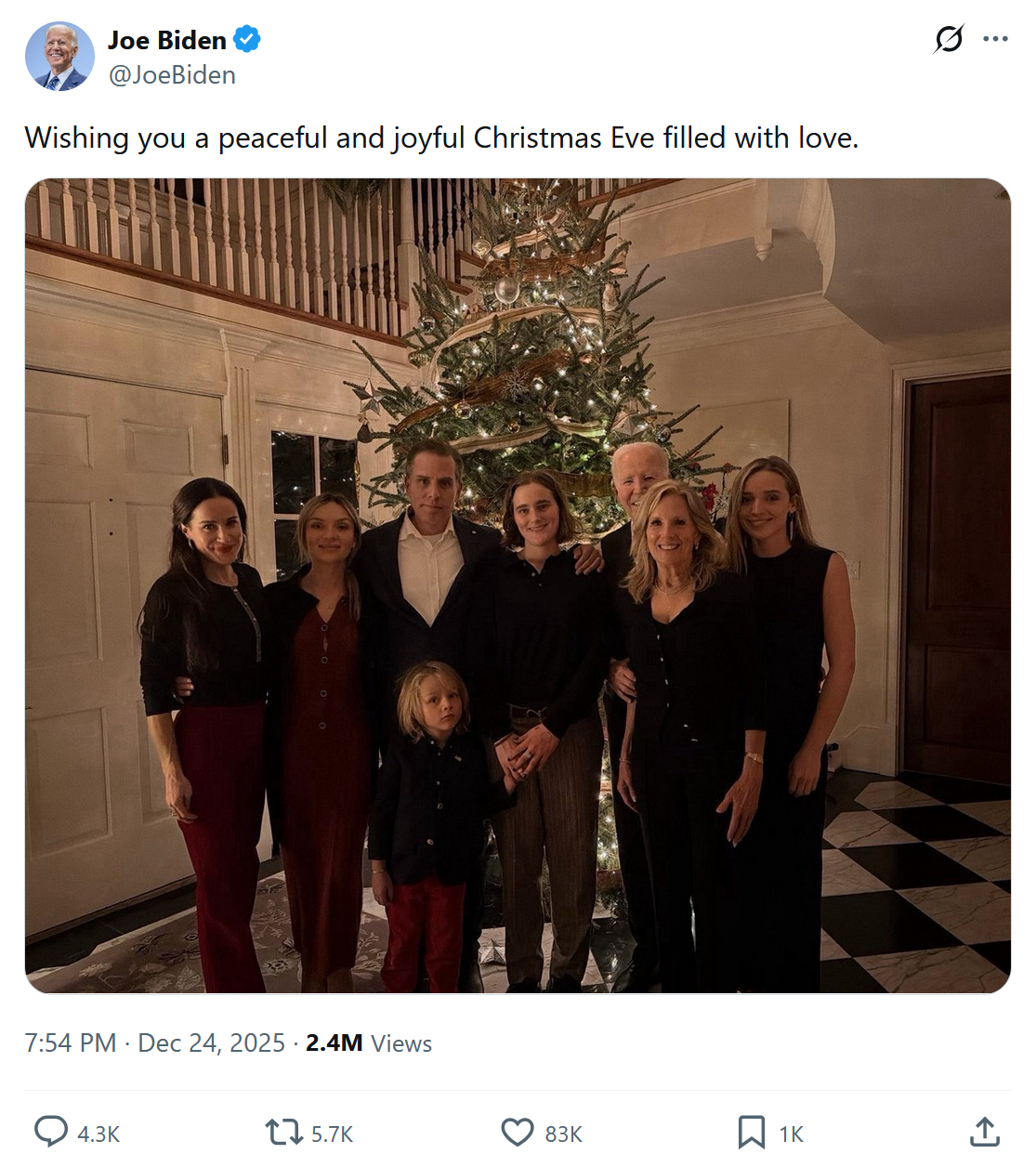
MORE: Biden shares perplexing family Christmas photo with Hunter front and center.
DEVELOPING:
— Katie Pavlich (@KatiePavlich) December 25, 2025
UPDATE: Breaking: Trump Announces Deadly Strike vs. ‘ISIS Terrorist Scum’ in Nigeria.
The @FFRF took issue with me closing state offices to celebrate Christmas and sent a letter demanding I rescind my proclamation.
Christmas isn’t a just a holiday, it’s the celebration of Jesus Christ’s birth. Meaning matters, we won’t pretend otherwise.
See my response here ⤵️ pic.twitter.com/UciehY3GtS
— Sarah Huckabee Sanders (@SarahHuckabee) December 22, 2025
AT AMAZON, Shop Same Day Delivery. #CommissionEarned
MERRY CHRISTMAS!
HEH, INDEED:
If ”free Palestine“ propagandists want to claim Jesus as Palestinian, they are welcome to him, but they need to also claim Judas, the Sanhedrin, the mob that chose Barabas over Jesus, and all the other Judean actors whom Christians have laid the Deicide on, leading to centuries…
— David Bernstein (@ProfDBernstein) December 25, 2025
SOWELL CHRISTMAS:
He don't miss. pic.twitter.com/nntnym7GhD
— Thomas Sowell Quotes (@ThomasSowell) December 25, 2024
UPDATE:
Christmas has been stolen in Bradford
— Visegrád 24 (@visegrad24) December 25, 2025
MERRY CHRISTMAS:
THE SAN FRANCISCO STORY BEHIND THE ‘CHARLIE BROWN CHRISTMAS’ ALBUM:
Unique among those Christmas hits are the songs from “A Charlie Brown Christmas,” the 1965 animated Christmas special starring Charles Schulz’s “Peanuts” gang. The movie’s soundtrack might be the most recognizable jazz music in history. Piano player Vince Guaraldi’s renditions of classics like “Christmas Time Is Here” have become the definitive versions, and tunes like “Linus and Lucy” — which the gang jams to onstage — have reverberated through pop culture ever since.
Schulz has close ties to the Bay Area. Although born in Minneapolis, he moved to Sebastopol in 1958, then relocated to Santa Rosa in 1969, where he lived until his death in 2000 (a museum and skating rink were built celebrating his work). But the Christmas special’s soundtrack has uniquely San Francisco roots and, if not for a string of coincidences, may have never actually been heard by the public — let alone hit No. 2 on Billboard’s album chart 57 years later. A four-hour “super deluxe” version was released in October featuring material recently discovered in the Fantasy Records vaults.
Guaraldi was born in North Beach in 1928. After a brief stint at San Francisco State and a tour in Korea as an army cook, he hit the SF jazz scene and quickly received a contract from locally based Fantasy Records. While playing live around San Francisco, he picked up nicknames like “The Italian Leprechaun” (he was just over 5 feet tall) and Dr. Funk. He and his trio gained some popularity through covers of Antonio Carlos Jobim and Luiz Bonfa on their 1962 album “Jazz Impressions of Black Orpheus,” then had a bona fide hit with the B-side “Cast Your Fate to the Wind.”
It’s hard to believe, but prior to its self-inflicted Weimar-ification*, San Francisco quite a brilliant city.
Related: Charlie Brown’s Inside Job. What gives the 1965 Peanuts special its staying power? “All the suits had said no to the religious element in the special, but Schulz insisted. Everyone at the network was prepared for a flop, but Schulz wasn’t thinking of network executives when he made the special. He was thinking about children and about the nature of God. The suits didn’t understand it, but from the first broadcast, the kids who watched it loved it, and made it a huge hit from then on.”
More: How Charles Schulz Got the Gospel Past CBS Execs in A Charlie Brown Christmas.
READER FAVORITE: ASUS Laptop Computer for Home Student Study Business. #CommissionEarned
HOW A TELEVISION ICON WAS BORN: Why We Still Love the Yule Log.
This Christmas, countless Americans will celebrate the holiday with the mesmerizing flicker of a yule log as a backdrop to their domestic festivities, the glow emanating not from a traditional fireplace but from their flat-screen televisions, perhaps “hung by the chimney with care.” Traditional holiday tunes will surely accompany the video, sourced from the catalogues of Frank Sinatra and Bing Crosby, or perhaps plucked from the more recent yuletide earworms of Mariah Carey and Paul McCartney.
The televised yule log has become commoditized, available on countless YouTube channels and streaming services, but all of these videos are knockoffs of the one true filmed fireplace that started it all — the WPIX-TV Yule Log.
In the fall of 1966, Channel 11 in New York City was a scrappy independent television station owned by the New York Daily News. An inventive general manager helmed the station, Fred Thrower, aptly named, as he threw off sparks of creativity to light up the station’s programming lineup when resources were tight and competition was fierce. One of those sparks would light a fire of holiday magic, adding an enduring element to Christmas celebrations, first in New York and, in time, around the world.
Inspired by a Coca-Cola commercial featuring Santa Claus, Thrower envisioned a televised fireplace that would serve as a Christmas gift for his viewers. WPIX’s core audience was in the five boroughs of New York City, where millions of people lived in cramped apartments without suburban amenities like fireplaces. Thrower would bring the fireplace into their urban living rooms, not through a monumental public works project, but via the 198-to-204 megacycles of his station’s analog signal emanating from atop the Empire State Building.
In November 1966, with the holiday just weeks away, Thrower challenged his executive staff to figure out how to produce a televised fireplace, accompanied by music. His team got to work, securing access to a grand fireplace at New York’s Gracie Mansion, the traditional home of Gotham’s mayor, then John V. Lindsay. The fireplace was shot on color 16-millimeter film that would be looped for the broadcast, and holiday music was selected with involvement from Thrower, relying heavily on the “beautiful music” format of the likes of Percy Faith, Ray Conniff, and other AM-radio old reliables of the era.
The WPIX Yule Log premiered on Saturday, December 24, 1966, at 9:30 p.m., preempting a telecast of a roller derby. The station lost money on the broadcast, as it has on every subsequent broadcast, simply because the Yule Log plays continuously for hours, and commercials, the bread and butter of station revenue, are suspended. For a few hundred minutes a year, commerce takes a back seat to cheer. Take note, Ebenezer Scrooges of the world.
Exit quote: “The Yule Log is a perfect example of ‘slow television,’ something that demands absolutely nothing of the viewer, if we can even call the person a viewer. It is designed less to be watched and more to set a mood and inspire feelings of comfort and joy, all while you entertain guests at a holiday party or open presents around the tree or just sit on your sofa and count your blessings with loved ones at your side.”
MERRY CHRISTMAS:
READER FAVORITE: 5 Precision Adjust Knife Sharpener. #CommissionEarned
LOL. WHAT LOSERS SAY.
FLASHBACK: Kamala Harris angrily scolds "how dare we speak Merry Christmas?! How dare we?!" because illegal immigrants may not get to celebrate Christmas.pic.twitter.com/J4S8uJZMJq
— MRCTV (@mrctv) December 22, 2025
UPDATE (From Ed): Compare and contrast:
Merry Christmas to all, including the Radical Left Scum that is doing everything possible to destroy our Country, but are failing badly. We no longer have Open Borders, Men in Women’s Sports, Transgender for Everyone, or Weak Law Enforcement. What we do have is a Record Stock…
— Donald J. Trump (@realDonaldTrump) December 25, 2025
ANSWERING THE IMPORTANT QUESTIONS: Why Jews Wrote Your Favorite Christmas Songs.
Much of the Jewish migration to the U.S. at the start of the 20th century came from the Pale of Settlement, the area ruled until the Russian Revolution by the Romanov dynasty. Jews were segregated into isolated towns known as shtetls where they were marginalized and often subjected to pogroms. Imagine, then, these people arriving at Ellis Island, where they were greeted by opportunity, diversity, and technology, finally free to express themselves in a new land.
They brought with them the Jewish musical tradition: the cantorial minor keys found in Jewish prayer. It’s no accident that Harold Arlen (born Chaim Arluck), the composer of “Somewhere Over the Rainbow” and “Stormy Weather,” was the son of a cantor.
Then, there was the Yiddish language, a hybrid tongue with words plucked from German, Hebrew, and other languages. Yiddish lends itself to surprising rhymes and pleasant meter. In this respect Yiddish is a lot like American music itself—an alchemy of cultures that create a delightful and unexpected new combination.
So it’s this combination of factors—the Yiddish language, the freedom America afforded Jewish immigrants, and the haunting minor key found in Jewish prayer—that help explain why Jews wrote so many of the great American songs.
They gave us the American songbook. George and Ira Gershwin, the brothers who wrote “I Got Rhythm.” Richard Rodgers and Oscar Hammerstein II, who together wrote “The Sound of Music” and many other unforgettable Broadway shows. The great Jerome Kern, one of the first breakout stars of New York’s Tin Pan Alley, who composed the scores for “Show Boat” and “Swing Time,” two of the first major modern musicals.
But if there was one man who embodied the alchemy of the Jewish American experience in a single life, it was Irving Berlin, the greatest American composer of them all.
A decade ago, Mark Steyn described the horrible turn that Berlin’s life would take on the way to writing “White Christmas:”
Christmas was not kind to Irving Berlin. At 5 o’clock on the morning of Christmas Day 1928, his 31/2-week-old son, Irving Junior, was found dead in his bassinet. ‘I’m sure,’ his daughter Mary Ellin told me a few years back, ‘it was what we would now call “crib death”.’
Does that cast ‘White Christmas’ in a different light? The plangent melancholy the GIs heard in the tune, the unsettling chromatic phrase, the eerie harmonic darkening under the words ‘where children listen’; it’s not too fanciful to suggest the singer’s dreaming of children no longer around to listen. When the girls grew up and left home, Irving Berlin, symbol of the American Christmas, gave up celebrating it. ‘We both hated Christmas,’ Mrs Berlin said later. ‘We only did it for you children.’
To take a baby on Christmas morning mocks the very meaning of the day. And to take Irving Berlin’s seems an even crueller jest — to reward his uncanny ability to articulate the sentiments of his countrymen by depriving him of the possibility of sharing them.
Berlin was a professional Tin Pan Alleyman, but his story, his Christmas is there in the music. 23 years after his death, he embodies all the possibilities of America: his family arrived at Ellis Island as poor and foreign and disadvantaged as you can be, and yet he wove himself into the very fabric of the nation. His life and his art are part of the definition of America. Whatever his doubts about God, Berlin kept faith with his adopted land — and that faith is what millions heard 70 years ago in ‘White Christmas’.
But then, as Mark Judge wrote last year: From Superman to Bob Dylan: How Jews enriched our culture.