MERRY CHRISTMAS:
December 25, 2025
THE SAN FRANCISCO STORY BEHIND THE ‘CHARLIE BROWN CHRISTMAS’ ALBUM:
Unique among those Christmas hits are the songs from “A Charlie Brown Christmas,” the 1965 animated Christmas special starring Charles Schulz’s “Peanuts” gang. The movie’s soundtrack might be the most recognizable jazz music in history. Piano player Vince Guaraldi’s renditions of classics like “Christmas Time Is Here” have become the definitive versions, and tunes like “Linus and Lucy” — which the gang jams to onstage — have reverberated through pop culture ever since.
Schulz has close ties to the Bay Area. Although born in Minneapolis, he moved to Sebastopol in 1958, then relocated to Santa Rosa in 1969, where he lived until his death in 2000 (a museum and skating rink were built celebrating his work). But the Christmas special’s soundtrack has uniquely San Francisco roots and, if not for a string of coincidences, may have never actually been heard by the public — let alone hit No. 2 on Billboard’s album chart 57 years later. A four-hour “super deluxe” version was released in October featuring material recently discovered in the Fantasy Records vaults.
Guaraldi was born in North Beach in 1928. After a brief stint at San Francisco State and a tour in Korea as an army cook, he hit the SF jazz scene and quickly received a contract from locally based Fantasy Records. While playing live around San Francisco, he picked up nicknames like “The Italian Leprechaun” (he was just over 5 feet tall) and Dr. Funk. He and his trio gained some popularity through covers of Antonio Carlos Jobim and Luiz Bonfa on their 1962 album “Jazz Impressions of Black Orpheus,” then had a bona fide hit with the B-side “Cast Your Fate to the Wind.”
It’s hard to believe, but prior to its self-inflicted Weimar-ification*, San Francisco quite a brilliant city.
Related: Charlie Brown’s Inside Job. What gives the 1965 Peanuts special its staying power? “All the suits had said no to the religious element in the special, but Schulz insisted. Everyone at the network was prepared for a flop, but Schulz wasn’t thinking of network executives when he made the special. He was thinking about children and about the nature of God. The suits didn’t understand it, but from the first broadcast, the kids who watched it loved it, and made it a huge hit from then on.”
More: How Charles Schulz Got the Gospel Past CBS Execs in A Charlie Brown Christmas.
READER FAVORITE: ASUS Laptop Computer for Home Student Study Business. #CommissionEarned
HOW A TELEVISION ICON WAS BORN: Why We Still Love the Yule Log.
This Christmas, countless Americans will celebrate the holiday with the mesmerizing flicker of a yule log as a backdrop to their domestic festivities, the glow emanating not from a traditional fireplace but from their flat-screen televisions, perhaps “hung by the chimney with care.” Traditional holiday tunes will surely accompany the video, sourced from the catalogues of Frank Sinatra and Bing Crosby, or perhaps plucked from the more recent yuletide earworms of Mariah Carey and Paul McCartney.
The televised yule log has become commoditized, available on countless YouTube channels and streaming services, but all of these videos are knockoffs of the one true filmed fireplace that started it all — the WPIX-TV Yule Log.
In the fall of 1966, Channel 11 in New York City was a scrappy independent television station owned by the New York Daily News. An inventive general manager helmed the station, Fred Thrower, aptly named, as he threw off sparks of creativity to light up the station’s programming lineup when resources were tight and competition was fierce. One of those sparks would light a fire of holiday magic, adding an enduring element to Christmas celebrations, first in New York and, in time, around the world.
Inspired by a Coca-Cola commercial featuring Santa Claus, Thrower envisioned a televised fireplace that would serve as a Christmas gift for his viewers. WPIX’s core audience was in the five boroughs of New York City, where millions of people lived in cramped apartments without suburban amenities like fireplaces. Thrower would bring the fireplace into their urban living rooms, not through a monumental public works project, but via the 198-to-204 megacycles of his station’s analog signal emanating from atop the Empire State Building.
In November 1966, with the holiday just weeks away, Thrower challenged his executive staff to figure out how to produce a televised fireplace, accompanied by music. His team got to work, securing access to a grand fireplace at New York’s Gracie Mansion, the traditional home of Gotham’s mayor, then John V. Lindsay. The fireplace was shot on color 16-millimeter film that would be looped for the broadcast, and holiday music was selected with involvement from Thrower, relying heavily on the “beautiful music” format of the likes of Percy Faith, Ray Conniff, and other AM-radio old reliables of the era.
The WPIX Yule Log premiered on Saturday, December 24, 1966, at 9:30 p.m., preempting a telecast of a roller derby. The station lost money on the broadcast, as it has on every subsequent broadcast, simply because the Yule Log plays continuously for hours, and commercials, the bread and butter of station revenue, are suspended. For a few hundred minutes a year, commerce takes a back seat to cheer. Take note, Ebenezer Scrooges of the world.
Exit quote: “The Yule Log is a perfect example of ‘slow television,’ something that demands absolutely nothing of the viewer, if we can even call the person a viewer. It is designed less to be watched and more to set a mood and inspire feelings of comfort and joy, all while you entertain guests at a holiday party or open presents around the tree or just sit on your sofa and count your blessings with loved ones at your side.”
MERRY CHRISTMAS:
READER FAVORITE: 5 Precision Adjust Knife Sharpener. #CommissionEarned
LOL. WHAT LOSERS SAY.
FLASHBACK: Kamala Harris angrily scolds "how dare we speak Merry Christmas?! How dare we?!" because illegal immigrants may not get to celebrate Christmas.pic.twitter.com/J4S8uJZMJq
— MRCTV (@mrctv) December 22, 2025
UPDATE (From Ed): Compare and contrast:
Merry Christmas to all, including the Radical Left Scum that is doing everything possible to destroy our Country, but are failing badly. We no longer have Open Borders, Men in Women’s Sports, Transgender for Everyone, or Weak Law Enforcement. What we do have is a Record Stock…
— Donald J. Trump (@realDonaldTrump) December 25, 2025
ANSWERING THE IMPORTANT QUESTIONS: Why Jews Wrote Your Favorite Christmas Songs.
Much of the Jewish migration to the U.S. at the start of the 20th century came from the Pale of Settlement, the area ruled until the Russian Revolution by the Romanov dynasty. Jews were segregated into isolated towns known as shtetls where they were marginalized and often subjected to pogroms. Imagine, then, these people arriving at Ellis Island, where they were greeted by opportunity, diversity, and technology, finally free to express themselves in a new land.
They brought with them the Jewish musical tradition: the cantorial minor keys found in Jewish prayer. It’s no accident that Harold Arlen (born Chaim Arluck), the composer of “Somewhere Over the Rainbow” and “Stormy Weather,” was the son of a cantor.
Then, there was the Yiddish language, a hybrid tongue with words plucked from German, Hebrew, and other languages. Yiddish lends itself to surprising rhymes and pleasant meter. In this respect Yiddish is a lot like American music itself—an alchemy of cultures that create a delightful and unexpected new combination.
So it’s this combination of factors—the Yiddish language, the freedom America afforded Jewish immigrants, and the haunting minor key found in Jewish prayer—that help explain why Jews wrote so many of the great American songs.
They gave us the American songbook. George and Ira Gershwin, the brothers who wrote “I Got Rhythm.” Richard Rodgers and Oscar Hammerstein II, who together wrote “The Sound of Music” and many other unforgettable Broadway shows. The great Jerome Kern, one of the first breakout stars of New York’s Tin Pan Alley, who composed the scores for “Show Boat” and “Swing Time,” two of the first major modern musicals.
But if there was one man who embodied the alchemy of the Jewish American experience in a single life, it was Irving Berlin, the greatest American composer of them all.
A decade ago, Mark Steyn described the horrible turn that Berlin’s life would take on the way to writing “White Christmas:”
Christmas was not kind to Irving Berlin. At 5 o’clock on the morning of Christmas Day 1928, his 31/2-week-old son, Irving Junior, was found dead in his bassinet. ‘I’m sure,’ his daughter Mary Ellin told me a few years back, ‘it was what we would now call “crib death”.’
Does that cast ‘White Christmas’ in a different light? The plangent melancholy the GIs heard in the tune, the unsettling chromatic phrase, the eerie harmonic darkening under the words ‘where children listen’; it’s not too fanciful to suggest the singer’s dreaming of children no longer around to listen. When the girls grew up and left home, Irving Berlin, symbol of the American Christmas, gave up celebrating it. ‘We both hated Christmas,’ Mrs Berlin said later. ‘We only did it for you children.’
To take a baby on Christmas morning mocks the very meaning of the day. And to take Irving Berlin’s seems an even crueller jest — to reward his uncanny ability to articulate the sentiments of his countrymen by depriving him of the possibility of sharing them.
Berlin was a professional Tin Pan Alleyman, but his story, his Christmas is there in the music. 23 years after his death, he embodies all the possibilities of America: his family arrived at Ellis Island as poor and foreign and disadvantaged as you can be, and yet he wove himself into the very fabric of the nation. His life and his art are part of the definition of America. Whatever his doubts about God, Berlin kept faith with his adopted land — and that faith is what millions heard 70 years ago in ‘White Christmas’.
But then, as Mark Judge wrote last year: From Superman to Bob Dylan: How Jews enriched our culture.
MERRY CHRISTMAS!
HOLIDAYS IN HELL: So This Is Christmas — and What Have Celebrities Actually Done?
As French authors would later conclude in their magnificent clean-up book on 20th-century communism, The Black Book of Communism, in 1999, nearly 100 million people died worldwide as a result of Marxist atheists.
To be sure, faith is no guarantee of a refuge from the evil that men do. Evil is also committed in the name of faith and by those who think they were/are on a mission from God. The Islamic Republic of Iran has been doing this since 1979, as one modern example.
However, it’s an analytical stretch that requires undue faith in the innate goodness of the religiously naked ape to believe atheism and atheist states will be any different from others who have complete power in a state. It’s an error to think that atheism will somehow thus serve as a peaceful refuge from humanity’s worst impulses. To believe this is to assume that religion — and not concentrated power — is the main problem in human affairs.
See China’s Xi Jinping today as the latest atheist incarnation of John Lennon’s imagined state and its consequences: a man on a mission for himself, who will run roughshod over his own population and others who want nothing to do with his view of how we should live. Xi’s repression is already obvious in China and in Hong Kong, and if he ever gets the chance, in Taiwan.
The same vapidity is evident in “Happy Xmas.” Its most famous line opens the song, and lodges in my cranium without asking permission: “And so this is Christmas/And what have you done?” Those ten words have enough hubris to inflate the Hindenburg. It’s as if ordinary folk somehow should justify themselves to a 1960s–1970s rock star consumed by self and by error, as in his musical worship of anti-religious belief and consequences.
The easy response from normal people to two celebrities who, by 1971, had been writing songs and giving interviews from their bedroom decked out in pajamas can be imagined as follows, perhaps from a single mom: “Oh, I don’t know, John — I’ve been raising three kids, caring for my aged Mom, and working double-shifts at the coffee shop to pay the bills. You?”
Other responses to imagine: From a Second World War veteran: “I fought my way on to Omaha Beach and survived D-Day — and the rest of the war, but many of my friends did not. We beat the Nazis, which is what mattered even more despite the sacrifices.”
Or imagine the response from a steelworker, miner, or farmer: “Endured another grinding day at the foundry/shaft/farm, this to afford the mortgage and Christmas presents.”
As Ian MacDonald wrote in Revolution in the Head: The Beatles’ Records and the Sixties, a trenchant analysis of the Beatles’ changing worldviews and how they fed their lyric writing, focusing on “The Ballad of John and Yoko,” an earlier attempt by Lennon to shift away from writing universal anthems to focusing on his day to day celebrity life:
Behaving as if they had personally invented peace, they jetted round the world in first-class seats selling it at third-rate media-events. This was arrogant as well as silly, and the news media’s derision, of which THE BALLAD OF JOHN AND YOKO self-righteously complains, was not only inevitable but, in the main, justified.
Of all the dangerous ideas Ono unloaded on her spouse around this time, the most damaging was her belief that all art is about the artist and no one else. Serving to confirm Lennon’s self-absorption, this also torpedoed his universalism, and it was as a man struggling to resolve this exacerbation of his lifelong emotional contradictions that he reeled from heroin to Primal Therapy to Maoism and finally to drink during the next three years. Otherwise scathingly honest, he unwittingly put himself into a position in which he was obliged to defend things that, deep down, he cared nothing about. Uncompromising as ever, he threw himself into this trap with total commitment, not only refusing to draw a line between his public and private life but going out of his way to personalise everything that happened in his vicinity, a self-centredness which could hardly avoid occasionally degenerating into paranoia, as THE BALLAD OF JOHN AND YOKO demonstrates. Indeed, so outrageously egocentric is this song that it’s difficult to know whether to deplore its vanity or admire its chutzpah in so candidly promoting Self to artistic central place.
In one of his last interviews, Lennon would finally admit, “I dabbled in politics in the late 1960s and 1970s, more out of guilt than anything. Guilt for being rich and guilt thinking that perhaps love and peace isn’t enough and you have to go and get shot or something, or get punched in the face to prove I’m one of the people. I was doing it against my instincts.”
His fans, though, cottoned on much more quickly: “The crowd I first saw the original [Let It Be before being Disney-fied by Peter Jackson] with weren’t interested in a happier spin on the Beatles. They were there to render judgment, to be the choric voice of the Beatles’ community declaring their disapproval. In other words, they were there to boo. They were there to boo Yoko Ono. If I remember the film correctly, the opening credits were barely done when we see John Lennon, and there is Yoko, sitting right beside him. ‘Boooo.’ Then, there is Yoko, knitting right beside him. ‘Boooo.’ For the length of the movie, every time Yoko was on camera, the crowd booed, as if to say, ‘Take that, Yoko, for breaking up the Beatles.’”
MERRY CHRISTMAS:
MERRY CHRISTMAS:
CHRISTMAS IN NAZI GERMANY: How Nazis Stole Christmas & Turned Adolf Hitler into Messiah (Video).
Earlier: The National Socialists Fought the Original War on Christmas.
Who knew? Other than everyone who read Jonah Goldberg’s Liberal Fascism in 2008, or this London Daily Mail article the following year. But it’s good to see this sort of thing in the Smithsonian’s house organ. Or as author Dave Shiflett quipped in 2002 at NRO, “A shocking story has been revealed: Adolf Hitler was not a Christian after all. Instead, he hoped to destroy Christianity.”
To borrow a line from another 19th-century born socialist God killer, as a reminder of the first time as tragedy and the second time as farce — while killing time before engineering the next tragedy — I found that above quote in a post of mine from right around this time in 2012. A few years before Angela Merkel turned the lights out on 21st Germany, Yahoo was reporting that “A minister in Angela Merkel’s government has sparked a pre-Christmas row among Germany’s ruling parties by suggesting God be referred to with the neutral article ‘das’ instead of the masculine ‘der.’”
But then, political correctness is what governments do in order to ignore their nation’s real, structural problems.
And in the adjacent world of International Socialism, Peter Hitchens: The last Noël in the USSR.
READER FAVORITE: Apple 2025 MacBook Air 13-inch Laptop with M4 chip. #CommissionEarned
MERRY CHRISTMAS:
COVID FOUR YEARS AGO: Jill breaks White House rules to go maskless as Joe is accused of staging bizarre dancing nurses show at the White House to distract from his catastrophic failure to order enough COVID test kits.
President Joe Biden was slammed on Thursday for holding Christmas festivities at the White House this week, complete with nurses singing ‘We Need a Little Christmas’ and a maskless First Lady, as critics claimed the event was ‘tone deaf’ and meant to distract from the president’s COVID policy failures.
The White House invited the famous Northwell Health’s Nurse Choir to perform at this year’s ‘Spirit of the Season’ TV special Tuesday night, and many were quick to point out the poor visuals of happy nurses singing amid the current Omicron surge.
The performance also featured some singers without masks, as well as a maskless Jill Biden off to the side, despite the White House’s indoor mask mandate in place.
To add to the schizophrenia, just a few days before the dancing TikTok nurses appeared with “Dr.” Jill,” the Biden Politburo was telling the rest of America — just in time for Christmas — that the Winter of Death was at hand:

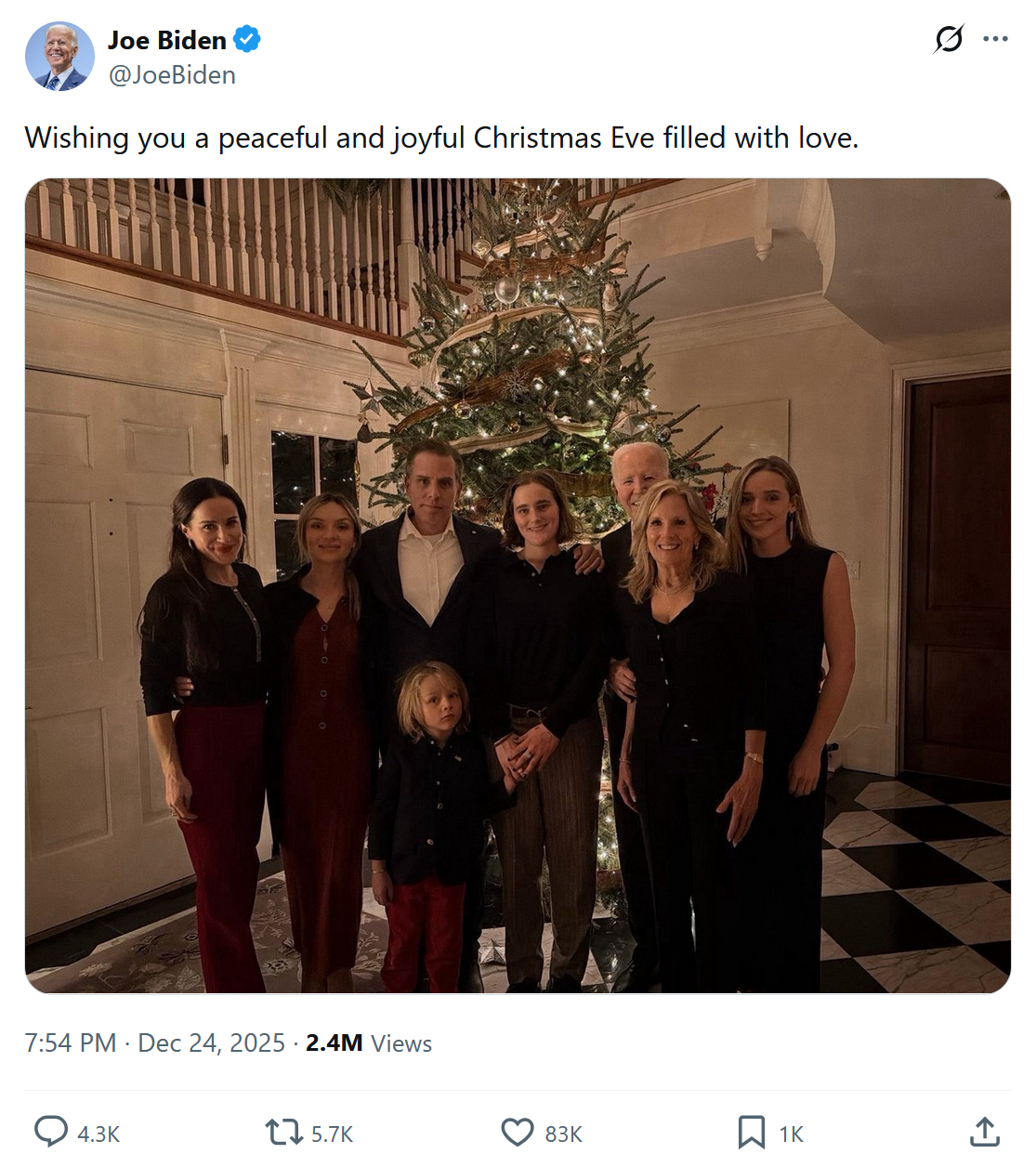
UPDATE: Merry Christmas from Hunter, “Dr.” Jill, and oh yes, the former president is (Photoshopped?) in there somewhere! — in the back of a gloomy, badly lit photo:
MERRY CHRISTMAS! The Critical Drinker’s Christmas Crackers — It’s a Wonderful Life (Video).
And for Mirror Universe version of the same story, It’s a Wonderful Fountainhead, too.
CHANGE:
Almost like we DEPORTED the murderers… 🤔
— Kyle Rittenhouse 🇺🇸 (@rittenhouse2a) December 25, 2025
MERRY CHRISTMAS:
HEH, INDEED: Trump tells children ‘coal is beautiful and clean’ while on Santa watch.
Donald Trump told children that coal is “beautiful and clean” as he asked young callers about what presents they wanted from Father Christmas this year.
The US president marked Christmas Eve by quizzing children on their wishlists, while promising to not let a “bad Santa” infiltrate the country and even suggesting that a stocking full of coal may not be so bad.
Mr Trump and Melania, the first lady, spoke to children from Mar-a-Lago in the tradition of talking to youngsters who have called the North American Aerospace Defense Command (Norad), which tracks Santa’s progress around the globe.
Asked by an eight-year-old girl in Kansas what she would like Santa to bring, the answer came back: “Uh, not coal.”
“You mean clean, beautiful coal?,” Mr Trump replied, echoing a favoured campaign slogan he has long used when promising to revive domestic coal production.
“I had to do that, I’m sorry,” the president added, laughing.
It certainly beats the programming that blue state parents and teachers have been doing to kids for years: How to talk to children about their anxiety over climate change. But beyond the lack of environmental doomsday talk, will anyone in the DNC-MSM mention that after four years of Biden needing cue cards and cheat sheets just to simulate conversations with his party’s operatives with bylines, we once again have a president who can talk without a script?
He stopped doing anything unscripted after this great troll on Christmas Eve, 2021. 😂https://t.co/gLoy58KiJ3
— bird cheat (@birdcheat) December 25, 2025
UPDATE: Watch: Trump’s Humorous Moments Talking to Kids on Santa Hotline.
ONE OF SATURDAY NIGHT LIVE’S FUNNIER 21st CENTURY SEGMENTS: 2005’s Christmastime For The Jews. “Just watch it. And you don’t have to be Jewish. My WASP husband gets almost every joke.”
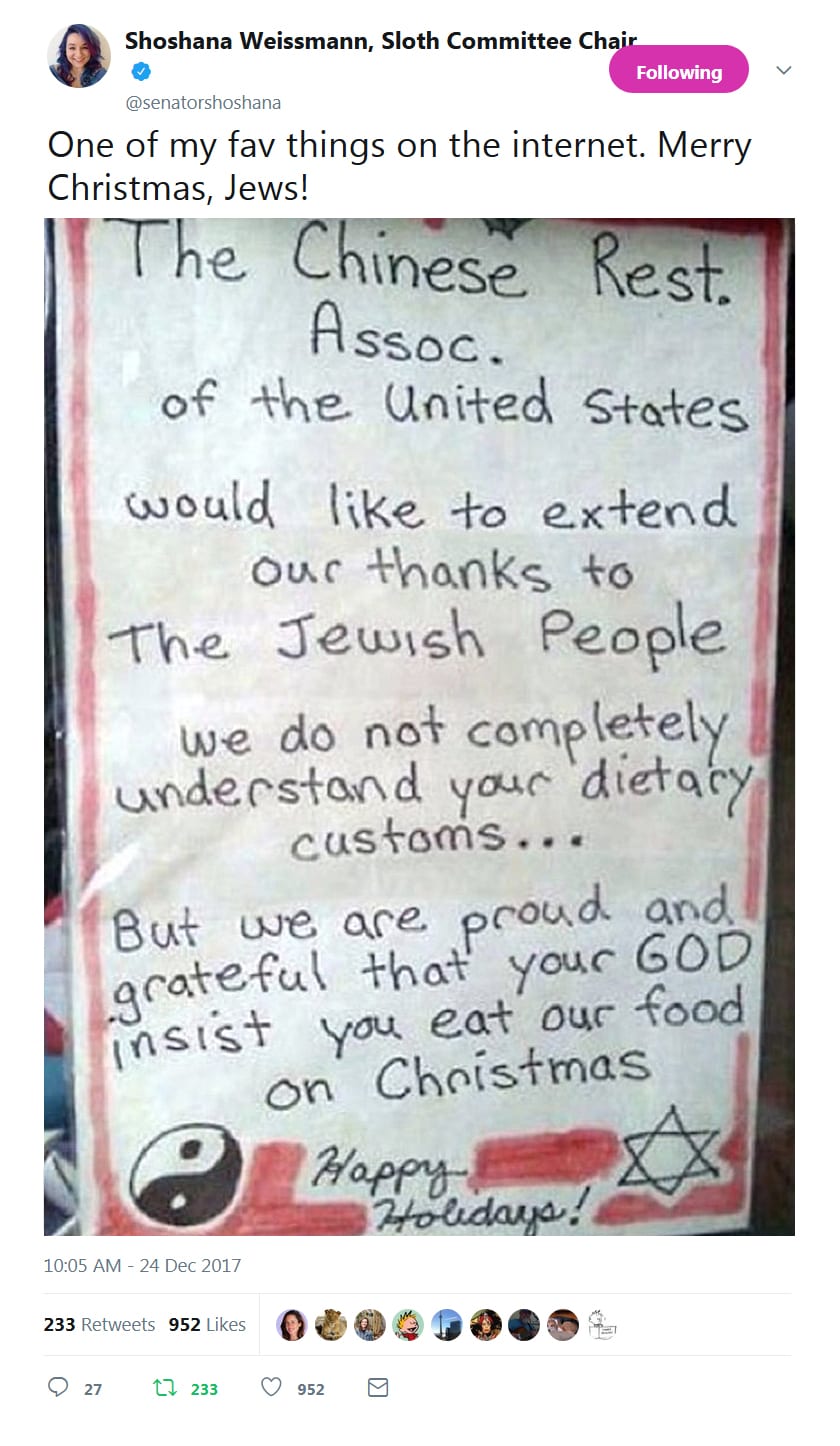
More: Differences Between Christmas And Hanukkah: The 2024 Snarky Edition. From the late and sorely missed Jeff Dunetz.
MERRY CHRISTMAS:
ASKING THE IMPORTANT QUESTIONS: Is Christmas really a pagan festival?
The celebration of Christmas is suffused with probable pre-Christian elements, from the Yule Log to the Lord of Misrule (an official appointed to oversee the festivities) but this should hardly surprise us. After all, the priority of early missionaries was to ensure that people came to believe in the Christian God. Customs with no direct bearing on the basics of belief were often left alone; for example, it was several centuries before Anglo-Saxon missionaries to Germany began to interfere in pre-Christian funeral rites or betrothal customs. The medieval church did not, as some think, demand control of every aspect of people’s lives. However, whether surviving pre-Christian customs should be called pagan is debateable, since ‘paganism’ seems to imply something to do with the cult of pagan deities. It is pretty clear that such cults disappeared fairly quickly, within a few decades of the Christianisation of most European nations, even if many other traces of pre-Christian culture remained.
So, is Christmas pagan? In the sense that Christmas is a festival that retains, in most cultures, elements of pre-Christian midwinter festivities, the answer can be yes – provided we’re prepared to use the word ‘pagan’ in quite a loose way.
I blame Saturnalia: