WELL, THOSE WEREN’T PRODUCED UNDER EMERGENCY WAIVERS: Poll: Most Americans confident in safety of routine childhood vaccines.
October 25, 2026
UTTER INGRATITUDE IS ONE OF ZELENSKY’S UNAPPEALING TRAITS:
Ukraine would have been overrun 10 times over if not for Musk giving them Starlink early on and denying Russia Starlink. The whole idea that he's some kind of monster because he also doesn't want people dying by the tens of thousands for nothing is insanity pushed by bad actors https://t.co/OK5kt3J72o
— John Hawkins (@johnhawkinsrwn) October 24, 2026
HOW CAN WE MISS HIM IF HE WON’T GO AWAY?
Democrats and Barack Obama told us American manufacturing jobs “are just not coming back.”
President Trump just announced Audi is building a $4.2 billion manufacturing plant in the United States.
Turns out putting America First works! 🇺🇸 pic.twitter.com/CZsxv1FgsQ
— Lance Gooden (@Lancegooden) October 25, 2026
WHAT EVERY FAMILY NEEDS: 2028 Mercedes-AMG GT SUV First Look: 1,153 Horsepower Reporting For Family Duty.
CHRISTIAN TOTO: Spencer Pratt, Gad Saad Slam Princess Bride Alum Over El-Sayed.
[Abdul El-Sayed has] gone on record saying Israel is not our ally, a confounding statement unless you consider he may hold the nation’s Jewish identity against it.
He’s campaigned with Hasan Piker, a hate pundit with strong anti-Israel beliefs.
He has refused to say if Israel has the right to exist.
Given that context, here’s what [Mandy] Patinkin had to say about El-Sayed.
Help get @abdulelsayed elected to the senate! Jewish safety depends on a real multiracial democracy [emphasis added]—and Abdul is the one fighting to protect it.
We know how much it matters to live in a country where our rights are protected, where the law applies equally to everyone, and where the majority can’t just decide that some people don’t deserve the same freedoms. The safety and freedom we’ve found in America didn’t happen by accident. They exist because of democracy. And protecting democracy means protecting Jewish safety, too.
Author/pundit Gad Saad (“Suicidal Empathy”) didn’t mince words about the actor, calling him a “Self-Loathing Degenerate, Lobotomized Wood Cricket Jew.”
Here we go: @PatinkinMandy is a Self-Loathing Degenerate, Lobotomized Wood Cricket Jew.
I despise Patinkin more than I do @AbdulElSayed. pic.twitter.com/RBsWvfqXsr
— Gad Saad (@GadSaad) October 23, 2026
Former Mayoral candidate Spencer Pratt blasted Patinkin on X as well.
“In order to protect the flock, we must give the henhouse keys to the fox. The fox understands the dangers we face better than anyone!”
Speaking of which, from the comment section: “Mandy is the runaway winner of the Chickens for Colonel Sanders Award.”
JEREMY CLARKSON: You can’t build there, newts need a view of Saturn.
Back in the summer, I was offered a large amount of hardcore which I wanted to use to provide hard standing in the field we use as a car park at my pub. And I was keen to get cracking for two reasons: firstly, it was a limited-time offer and, secondly, I wanted it in place before the winter rains turned the field into a mud bath.
Urgency, however, is not a word that’s fully understood by local authorities. So I’m sitting here today, with the rain falling, and we can’t get permission. We’ve rung. We’ve begged. We’ve pleaded. We’ve explained that if we don’t do the work now we will lose the hardcore and, all winter, our customers will be dragging tons of mud onto the roads. And all we get back is silence.
There are similar problems, still, at the farm shop. We need to know what we are allowed to do up there in the coming years and it’s like we are dealing with Helen Keller. Nearly 300 people are employed by my various enterprises these days. And all of them want to know if their jobs are secure. So too do the owners of all the cafés, antique shops and guesthouses in the area who rely on Diddly Squat’s popularity for much of their business. And all we can ever tell them is: “We don’t know.”
There’s no doubt that the planning system in this country is broken, and I suspect it’s because far too many people are invited to have an opinion on each application. When we wanted the restaurant, we even had to ask the police what they thought. And then you have to ask the Environment Agency and Historic England and Natural England and the parish council and your local water company and the highways department and the county council and they’re all going to chime in, because if they don’t, they’re admitting their jobs are pointless.
Give them a break Jeremy – England’s local councils are simply trying to prevent the nation from descending into a bear market:
A Council official turned up at the home of YouTube pianist Brendan Kavanagh—better known as Dr K—to investigate his 12-year-old daughter Zoe’s pretend teddy bear cafe for illegal trading.
Yes, really. Stuffed animals, toy tea sets, play money, and a handwritten “prices” sign in a family property triggered a formal Bedford Borough planning department visit after a complaint about an “illegal cafe.”
Kavanagh filmed the arrival and the tour. The official showed ID outside, then walked through the setup of teddies around a table with cups and cakes. Obviously, no actual trading was happening with real customers. Just a child’s game in a private home. Threatening letters had already arrived from the council’s planning department.
For those of you who thought the visit from a Bedford Borough Council official to investigate our daughter Zoe’s (age 12) pretend teddy bear cafe was too ridiculous to be real, here is the arrival of official. This is totally legit. She really did show up at our property to… pic.twitter.com/KLJPI6sUcl
— Brendan Kavanagh (Dr K) (@brenkav) October 24, 2026
The official appeared to have done almost no homework. She referenced a website tied to the complaint but showed little grasp of what she was actually investigating or the basic facts before grilling the family at their own home. This is the same local authority environment that has previously sent multiple officers to the Kavanagh property.
Another crazy incident in our old house (now sold) – We got visited by an official from the planning department for Bedfordshire Borough Council Why? Because Zoe’s (age 12) toy cafe got reported for illegal trading. I kid you not. We had to show the lady around our property to… pic.twitter.com/dOfqifwtY0
— Brendan Kavanagh (Dr K) (@brenkav) October 24, 2026
Armando Iannucci, the writer/director of The Death of Stalin and the creator of HBO’s Veep series is currently working on the next Paddington movie. Real life in England has just provided him plenty of satiric content.
PROTECT YOUR BACK: 3-in-1 Forestry Multitool. #CommissionEarned
MARK FELTON: The Eagle’s Nest Fire — Erasing History at Obersalzberg.
I REMEMBER WHEN BRITISH POLICE WERE HIGHLY REGARDED: When the UK’s Met Police Show Off Their Award-Winning Armed Cop And She’s Doing Everything Wrong.
GET ENOUGH MAGNESIUM: BIOptimizers Magnesium Breakthrough 500mg. #CommissionEarned
THEY TELL YOU NOT TO DO THAT: Ian Brinksman Arrested: Caught in a Honeypot?
“MAY YOU BURN IN HELL:” Musk Clarifies Why Starlink Speed Limits Were Throttled In Ukraine. “‘Using Starlink, a civilian commercial service, for offensive drone strikes to kill people has never been allowed, nor should it be,’ adding that Starshield, ‘a different system, is controlled by the US government. What they decide to do is up to them.’ The rest of the post, as AP quotes it: ‘Ukraine military violated Starlink terms of service and used it for offensive drone strikes to kill people. That loophole was closed last week.’”
A SUNDAY QUESTION: Did Jesus really claim to be God? Bart Erhman, who is perhaps the most widely skeptic on this question, and Wes Huff, a Canadian evangelical who is a rising star in the Christian apologetics field, lay out their arguments in succinct fashion for an informative discussion on HillFaith.
QUESTIONS ASKED AND ANSWERED: How Did Japan Stay Japan? Why Are We Disappearing?
TRAINING YOUR REPLACEMENT: Wearable system captures human activity data for robot training.


BECAUSE IT’S A GOOD IDEA: Why Trainers Recommend Power Training for People Over 50 to Boost Strength and Mobility.
LIGHTNING DEAL: ALORAIR Air Scrubber with 3 Stage Filtration. #CommissionEarned
AMERICA’S NEWSPAPER OF RECORD:
Oh No: Atlanta Falcons Announce Surprise Game In Paris https://t.co/eE7nGgcQMK
— The Babylon Bee (@TheBabylonBee) October 23, 2026
FASTER THAN A TESLA MODEL S PLAID! Critical Musk documentary pulled from theatres after just two weeks. The film concludes its theatrical run with a $571,902 box-office performance.
Despite its critical praise, Alex Gibney’s Musk documentary about the world’s richest man is ending its theatrical run after just two weeks, according to entertainment news site Showbiz411.
Upon its release on Oct. 9th, Musk was shown in just four theatres in two cities nationwide, but that number rose to over 450 by the second (and ultimately final) week of its theatrical run, though the total take, according to Gizmodo, was a paltry $571,902, making it “an unmitigated flop.”
But could there be something else at play here other than simple box office math?
Err, yes?
Wait… was it pulled or did it just get a 2 week Oscar-qualifying run? https://t.co/0516EeKkcc
— George MF Washington (@GMFWashington) October 25, 2026
JULIE BURCHILL: The ‘homicidal empathy’ of the Islamo-left.
We certainly see a massive dose of suicidal empathy among the Islamo-left, from Queers for Palestine – often mocked as Turkeys for Christmas – to Owen Jones. Jones probably thinks that he’s so unique that he could sprout wings and fly if he got thrown off a Gazan roof by the local gay-haters. Do these fools honestly believe that the facts about Hamas hating homosexuals are Israeli propaganda? Or are they so bound up in The Wonder Of Me, so convinced of their exceptionalism, that they are as deluded as that strange girl on TikTok, who mused on how she would be treated if taken hostage by Hamas: ‘They would probably comfort me, make sure I had medical attention, make sure I was doing okay…’
The message is loud, clear and strikingly ignorant. Other women / gays / infidels may get raped and / or murdered, but those big angry men would see me as special. We assume that such people are simply thick, or perhaps suffering from extreme narcissistic exceptionalism. A lot of them are mad at their parents and are acting up or acting out. Is it performative social masochism, in which liberal young white folk seek to outdo each other as if in some silly and sinister sport?
As Mark Steyn wrote 20 years ago, “our tolerance of our own tolerance is making us intolerant of other people’s intolerance, which is intolerable. And, unlikely as it sounds, this has now become the highest, most rarefied form of multiculturalism. So you’re nice to gays and the Inuit? Big deal. Anyone can be tolerant of fellows like that, but tolerance of intolerance gives an even more intense frisson of pleasure to the multiculti masochists.”
The Islamo-left’s “homicidal empathy,” as Burchill dubs it, leaves them little empathy for its victims: The face of France’s far-Left madness: Pro-Palestine ‘feminist’ tells woman who was threatened with rape during French protests that she is ‘collateral damage.’
But then, this is nothing new; in his 1945 essay “Catastrophic Gradualism,” George Orwell famously noted that when it comes to his fellow leftists:
The formula usually employed is ‘You can’t make an omelette without breaking eggs.’ And if one replies, ‘Yes, but where is the omelette?’, the answer is likely to be: ‘Oh well, you can’t expect everything to happen all in a moment.’
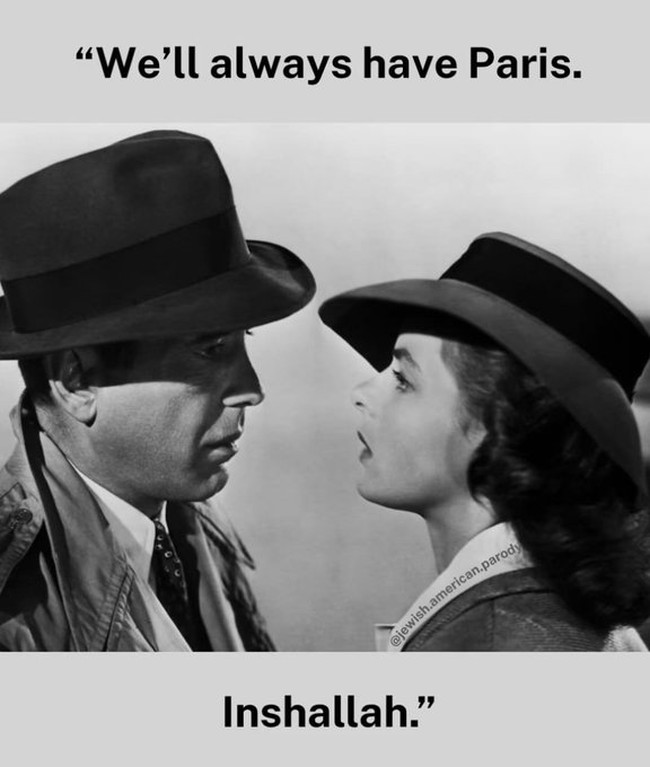
When the omelette finally arrives though, it will definitely be halal.
UPDATE:
This video is very important for Europe. It shows that those who loot, destroy cars, set fires and cause chaos speak Arabic. And if they speak Arabic, they are not Europeans. Let's assume many people won't want this video to spread, because it tells too much truth. pic.twitter.com/lVaRM2AKpf
— RadioGenoa (@RadioGenoa) October 25, 2026