GET YOUR VITAMINS: Ensure Max Protein Milk Chocolate Shake. #CommissionEarned
September 10, 2026
I DON’T HAVE ANY TROUBLE SLEEPING IN LIGHT, BUT THE INSTA-WIFE KEEPS OUR BEDROOM PITCH-DARK, WHICH I GUESS IS GOOD. The hidden risk to your heart from sleeping in low light.
DYNASTIC COMMUNISM IS WEIRD: S. Korea trying to learn if Kim Jong Un has a son but daughter’s status appears solid.
THEY KILLED HIM BECAUSE HE WAS EFFECTIVE:
You know someone was an effective anti-communist when the leftist cockroaches celebrate that person’s death.
But when the bastards celebrate the ANNIVERSARY of someone’s death….that person was an anti-communist JUGGERNAUT.
Strive to be as effective as Charlie. Every day.
— Oilfield Rando (@Oilfield_Rando) September 10, 2026
PLEASE DON’T UNFAIRLY EXCUSE THE LIBERAL WHITE WOMEN AND UNIONS:
You are unfairly excusing liberal white women and unions,
— (((Road Bear Life))) (@bearshrugged) September 10, 2026
NO SUCH THING AS BAD PUBLICITY FOR NETFLIX? Netflix appears to mock Charlie Kirk over ‘neck injury’ on 1-year anniversary of his murder as calls to boycott grow.
Netflix’s official UK and Ireland account made a post on Thursday, the one-year anniversary of Turning Point founder Charlie Kirk’s assassination, appearing to mock the conservative figure’s killing.
The post stated, “Nearly did himself a neck injury.” The post included screenshots of what appears to be season two of the Guy Ritchie series The Gentlemen. Kirk was fatally shot in the neck during a stop at Utah Valley University on September 10, 2025.
The post quickly drew backlash across social media. Libs of TikTok wrote, “Woke Netflix hates us. So glad I cancelled my subscription.”
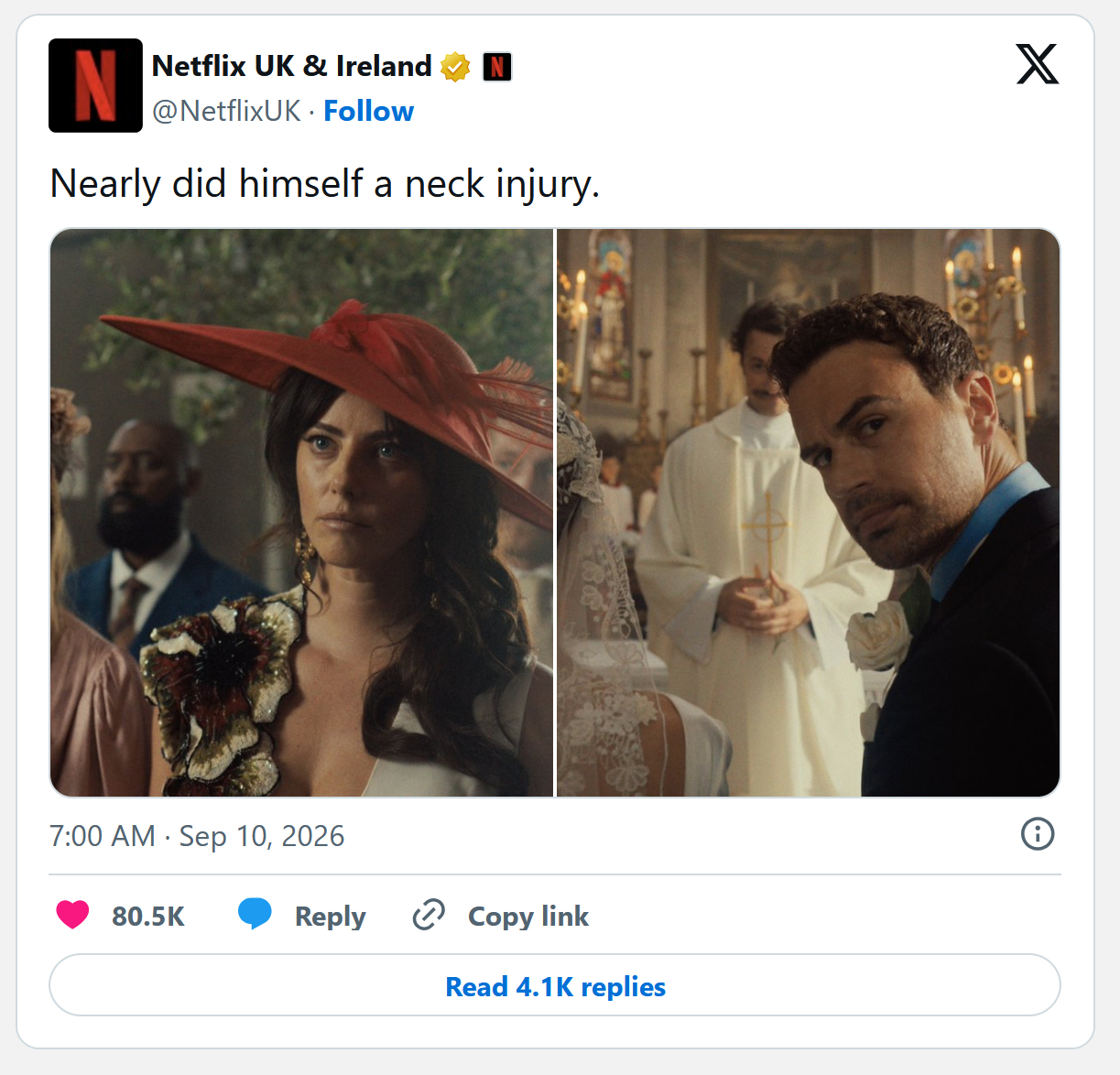
Funny, the Critical Drinker was raving about The Gentlemen yesterday. Apparently, Netflix doesn’t want to broaden its show’s audience.
LIMITED TIME DEAL: roborock Qrevo CurvX Robot Vacuum and Mop, 22,000Pa Suction. #CommissionEarned
DEMOCRATS LOVE REGULATING SPEECH UNTIL THEY DON’T.
In fact, he is allowed to interview James Talarico. Maybe he didn’t tell you that because he knows you’re kind of dumb and don’t understand that there is an equal time obligation under the law. He would have to give Paxton equal time and he doesn’t want to do that.
Did your hero… https://t.co/1U2VxSHVZu
— Kurt Schlichter (@KurtSchlichter) September 10, 2026
LAWRENCE PERSON: My Friend Was Murdered On Labor Day. “Andrew Wimsatt, a friend for over thirty-five years, a regular member of the Saturday Dining Conspiracy (and the movie night afterwards) and an all-around standup guy, was murdered on Labor Day.”
More:
I looked into whether some of the themes covered by this blog applied to Andrew’s murder, but as far as I can tell Ogbodiegwu was not an illegal alien and does not appear to have been released on bail for previous offenses in Travis County.
Even more, from another old online acquaintance:
Andrew was my friend. My heart is broken and I’m full of rage. He did not deserve to die like this. Fuck that piece of shit and everyone responsible for Andrew’s murder. FUCK THEM https://t.co/saEoTlp2QA
— 🏈 Duchess of Football 🏈 (@AnnaDsays) September 10, 2026
“Based on preliminary evidence and information developed so far, investigators believe the attack was a random act and that the victim and suspect were not known to one another,” according to the Williamson County Sheriff’s Office.
UPDATE: He was a friend of David Burge, too. It seems like everyone in and around Austin knew and liked Andrew.
I am very saddened to learn that my friend @ajwimsatt was incomprehensibly murdered Monday. He was a gentle and generous soul, a frequent contributor to Dave's Car ID Service, and a big supporter of my son's music. He will be greatly missed.https://t.co/iAf4XZcv0A
— David Burge (@iowahawkblog) September 10, 2026
THE GERMANS ARE FUNNY, JUST NOT HA-HA FUNNY:
Germans are so funny. They can't stop talking about the decline of democracy in the US under Trump but then they suggest to just ban the party that just won in Germanyhttps://t.co/5esPgWYl2R
— Bryan Breguet (@Prominent_Bryan) September 9, 2026
Same goes for Brussels:
After the AfD's election win in Sachsen-Anhalt, Brussels is openly discussing freezing the state's EU funding — roughly €2.95 billion in the current budget period, about €500 million per year, making up ~20% of the state's investment spending.
The precedent is real.
The EU… pic.twitter.com/NdZyhvWO8f
— Clash Report (@clashreport) September 10, 2026
I’ve never understood why Europeans vote to join the EU, because it’s the last time their vote really counts.
IS THIS AGAIN OR STILL? Iran ‘Cannot Survive Like This Much Longer’…AGAIN.
TREAT YOUR LIPS: Jack Black Intense Therapy Lip Balm. #CommissionEarned
SALENA ZITO: Flight 93 crash in Shanksville on 9/11: ‘The first Americans to fight back against terrorists happened here.’
In the days, months and years that followed, it was discovered that the passengers and crew of Flight 93 believed the plane was heading toward the White House or the Capitol and, to stop that tragedy, they revolted against the four hijackers in midair. All 40 of them died along with their captors.
Duppstadt and her sister-in-law closed the store early that day and went straight to the local school to collect her three children. She went home and held them close.
“You never think something would happen in a place like here. You hope if it does the community comes together.”
The whole country did then.
TWANLOC (CONT’D):
"It's not about left versus right"
Meanwhile, the left is busy treating the day Charlie Kirk got killed like a literal religious holiday.
There is no "uniting" with this.
— End Wokeness (@EndWokeness) September 10, 2026
THE LONELY LIVES OF SCIENTISTS: Yes, scientists really built a “tickle robot.” Here’s why.
VIRGINIA POSTREL: The invention of the MMO. Despite running on computers with just 64 kilobytes of memory, Habitat became the first massively multiplayer virtual world in 1982.
Behind the first massively multiplayer virtual world was a home computer that was comically underpowered by today’s standards. Introduced in November 1982, the Commodore 64 was named for its then-generous 64 kilobytes of memory. In its twelve years on the market, it became the best-selling desktop computer in history. A conservative estimate puts its sales at 12.5 million machines worldwide.
The C64 sold for $595 in the US, compared to about $1500 for an Apple II with just 48 kilobytes of memory, and £399 in the UK. The computer, which looked like a thick keyboard, could use a TV as a monitor. Its operating system and the BASIC programming language were built into its hardware, requiring no disk to boot up. Typical for the time, an external drive to store and read software on floppy disks cost extra. Commodore, declared CEO Jack Tramiel, made ‘computers for the masses, not the classes’.
The C64’s low price was made possible by an unusual selection of chips. The CPU was a cheap, efficient, stripped-down industrial controller. The sound chip was designed for music synthesizers, the graphics chip for video games. The result was an inexpensive machine whose sound and 16-color palette were ahead of their time.
You know it had to be good when it was endorsed by one of the top representatives of Starfleet Command:

STRANGE BEDFELLOWS: A Remarkable Coalition Is Standing Up to the ‘Genocide’ Lie About Israel.
THIS RESONATES WITH MY EXPERIENCE: Can you tell someone will die months before it happens? A hospice nurse shares the clues.
DOJ: Report Illegal Aliens Or Lose Welfare Funding. “With Trump47, normal Americans are back in charge again, and illegal aliens are being deported just as the law requires. Now the DOJ is telling state welfare agencies that if they want to keep receiving welfare funding, they have to report illegal aliens on their rolls.”
Maybe we’ll find out what those rolls are really worth.
WE’VE DESCENDED INTO SOME SORT OF BIZARRE HELL-WORLD IN WHICH BOY GEORGE IS A VOICE OF SANITY:
In the last few months, my life has changed beyond all compare. I made a decision to support my Jewish friends and without hesitation. I feel anxious almost everywhere I go but I do not regret my decision. I have seen friends that I have helped and supported turn on me without a…
— Boy George (@BoyGeorge) September 9, 2026