OPEN THREAD: You know what to do.
October 22, 2026
AI DESTABILIZES STOCK PHOTO INDUSTRY: Getty Images files for US bankruptcy, advances restructuring plan. “Getty Images (GETY.PK) filed for Chapter 11 bankruptcy on Wednesday, formalizing restructuring plans unveiled more than a week ago as part of its move to go private. Last week, Getty announced plans to file for bankruptcy, marking a major reset after its planned merger with rival Shutterstock (SSTK.N) collapsed under the weight of heavy debt and growing competition from AI-generated imagery.”
The DALL-E image generator in ChatGPT is capable of producing photo-realistic images, and other AI image generation platforms can produce material good enough to illustrate online ads and Websites, and for much cheaper costs than maintaining an account at Getty or Shutterstock. Not to mention, the platforms merely have to be prompted to produce their results, rather than the labor-intensive efforts that Photoshop used to require to assemble a collage of stock photos into a satiric image, as I used to do every night for PJM, back in the day. At worst, Photoshop can be used to tweak an AI image, rather than the drudgery of starting from scratch.
HMM: Could a $200K bond for satellites paid before launch prevent a space junk disaster in orbit? Here’s why some scientists think so. Scientists aren’t exactly experts at regulatory matters. This isn’t promising:
“Low Earth orbit looks like lots of other resources that we have trashed as economic actors,” Daniel Kaffine, a professor of environmental and resource economics at University of Colorado Boulder, told Space.com.
(1) Resources are generally more trashed by governmental actors. Most space debris created in recent years has come from Chinese and Russian military posturing. For that matter, the environmental record of governments in general is much worse than that of “economic actors.” See, e.g., the Aral Sea, the Gold King Mine/Animas River EPA spill, etc.
(2) I question the value of space regulatory advice from a “professor of environmental and resource economics.” Nor is such a person a “scientist.”
(3) That said, the bond idea isn’t a bad one except that (a) there’s nobody empowered to impose the requirement; and (b) there’s nobody empowered to administer it.
I recommend space salvage. The Outer Space Treaty is a barrier, but we could probably end run it via the Artemis Accords.
AMERICA’S NEWSPAPER OF RECORD:
Ilhan Omar Says She Didn't Know She'd Married Her Brother As They Were Separated At Birth And Hidden From Their Father, Darth Vader https://t.co/LioPMYHOiG
— The Babylon Bee (@TheBabylonBee) October 22, 2026
THERE WAS NO PRELAPSARIAN GOLDEN AGE: 75,000-Year-Old Neanderthal Skeleton Reveals a Mysterious Spear Wound Aimed at the Heart. Life was nasty, brutish, and short.
WE’VE DESCENDED INTO SOME SORT OF BIZARRE HELL-WORLD IN WHICH THE FRENCH POLICE ARE A VOICE OF SANITY: French Police Identify Antifa as the “Ideologically Distinct Group” Behind the Riots Despite Democratic Denials.
WELL, THAT’S DISAPPOINTING. There is no magic diet.
THE 21st CENTURY ISN’T TURNING OUT AS I HAD HOPED: Google Didn’t Invent This Racial Double Standard, but It Learned It.
Another medical journal declares that “There is no good clinical reason for choosing a white doctor rather than a doctor from an ethnic minority.” And these are the types of sources that Google is drawing on for its AI responses to questions like the ones I asked.
Honestly, I’m not sure why anybody would limit the doctors from whom they receive care to certain ethnicities, but we shouldn’t see such a disparity in the responses. It’s easy to simply dismiss it as bias on Google’s end, and that’s a big part of the problem. But what we also see is that medical academia is the source of heavy bias that Google is drawing from.
Google didn’t invent this double standard. It simply repeated what influential voices in medical academia have already decided: that the same preference can be perfectly reasonable or potentially racist depending on who’s expressing it. And when that sort of thinking becomes the foundation for the information Americans receive, the problem goes well beyond a biased search result.
Equal treatment shouldn’t come with a racial exemption.
Still though, it’s Google, so it could always be much has worse: Google’s AI Debacle. Why is Google creating pro-Nazi and pro-Confederate propaganda?

IN SOME COMMUNITIES, SHE’S BEEN A LAUGHINGSTOCK ALL ALONG:
If this is true, she is now a laughingstock in the Somali community. https://t.co/qvHfJR67yj
— Skin that smokewagon! (@heatpacker) October 22, 2026
ALL THIS AND WORLD WAR ELEVEN: Oh, Brother: ‘Not to My Knowledge?’
Rep. Ilhan Omar (D-Minn.) on Wednesday called allegations that she married her brother “insane” – but didn’t entirely close the door to the possibility of being related to her ex-husband.
“Not to my knowledge,” Omar responded, when asked by MS NOW’s Chris Hayes if there was any “weird kernel of truth” to the claim that she wed her brother.
The decade-old allegations that Omar and her ex, Ahmed Nur Said Elmi, got hitched in a failed effort to get him a green card originated on a “Somali blog,” and spread when “right-wing conspiracy theorists” latched onto it, Omar explained in her first interview since federal agents raided her Washington, DC, home last week.
As Ed Morrissey concludes, “Get ready for bumpy days ahead, Ms. Omar-ish. And maybe M-SNOW ‘news’ anchors might try to catch up at some point rather than chuckle through a scandal that has unfolded for years.”
THE BIRD REICH: Did the Atlanta Falcons Nazi What Their New Profile Picture Looks Like?
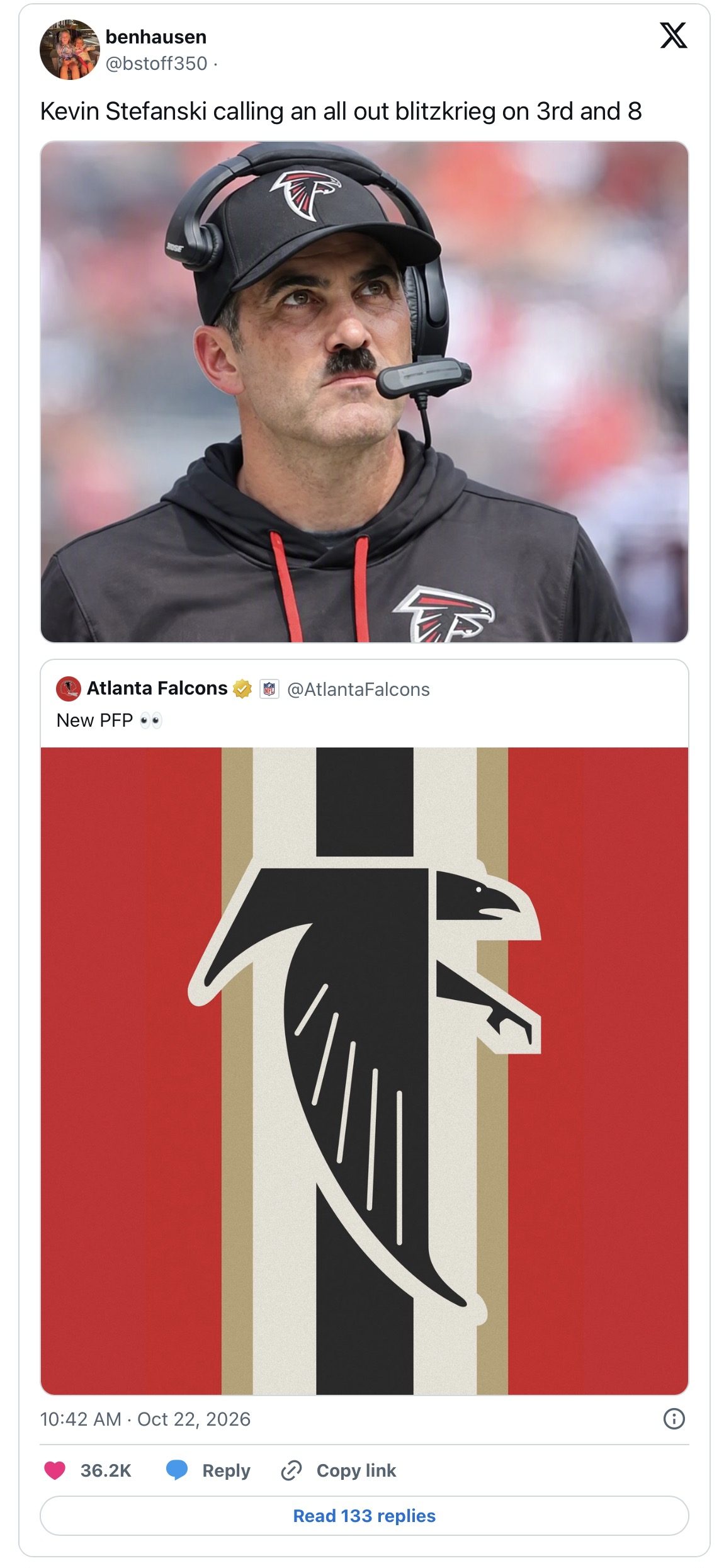
Geez, not another fascism-adjacent team in the NFL: The Other NRA (Or How the Philadelphia Eagles Got Their Name).
Sometimes the younger guys will take a look at TikTok and hear the screaming, crying lunatic women, either doing the usual rant about men or sobbing because no sane guy will come within twenty miles of her. There is a certain joy in the whiner’s misfortune, otherwise known as Schadenfreude, but almost immediately they will scroll over to look at guitars, sports cars, or check the score of the ball game. On the whole, the entire thing has become incredibly boring.
For years we did listen, actually until about seven or eight years ago. We listened through the ’80s, the ’90s, and the early 2000s, and then things began to change. We were dragged into Human Resources training and told we had to answer for scumbags like Harvey Weinstein and all the “sensitive” actors and Hollywood types that we knew were scumbags all along—and who were, incidentally, celebrated by women. We were told that we had to answer for Bill Clinton, when most men with even an ounce of testosterone despised the guy. The whole parade of #MeToo was apparently a shock to liberals, and especially liberal women, but there wasn’t a conservative guy on earth who couldn’t see these scumbags coming from miles away. Big shock that Hollywood producers, rock stars, politicians and celebrities might actually take advantage of a woman.
We listened as decent, hardworking men were lumped in with fictional characters like Don Draper, and we were told that somehow a sliver of revolting advertising guys from Manhattan represented all men. We listened through corporate diversity seminars that explained to us that when Neal grabbed Barb’s butt in the elevator, this was a bad thing. Thanks for the clarification. We listened as we were now expected to answer for creeps in New York and Los Angeles newsrooms and politicians who were sexting pictures of their weenies to their staffers, as though the rest of us had been consulted beforehand and somehow approved the plan.
We listened to all the lectures in college about toxic masculinity, which eventually seemed to encompass everything from men breathing oxygen to hiding in the garage. We listened while we were told that using rational argument was “mansplaining,” that “math was racist,” and abortion was “health care.” We heard all about the male gaze, so we stopped looking. We listened as we were told that women wanted to be judged equally in the workplace, except when they didn’t. Disagreement was fragility, attraction was objectification, and somehow lack of attention was discrimination. Opening the door for a woman was paternalistic, but not opening it was rude.
And thus we get to this recent moment, without much thought to the multiple steps in the cultural revolution leading up to it:
What, precisely, obligates men to perform physical tasks at the behest of woman in our vicinity?
In turn, what tasks should we expect women to perform for us on our behalf, when we deem it necessary?
— El Jacobo (@eljacoboaqui) September 18, 2026
As Glenn likes to say, chivalry was a code that made behavioral demands on women as well as men.
THE FUTURE HAS ARRIVED — ON YOUR DRIVEWAY TO TAKE YOU WHEREVER YOU WANT TO GO:
Remember, the goal isn't perfection. The goal was "safer than the average taxi driver." And that goal has already been reached. Now (and presumably hereafter) the goal will be "safer than the previous version." https://t.co/qLiYpZZ3tV
— Jay W. Richards 🇺🇸 (@DrJayRichards) October 22, 2026
HEH: Cut the Crap — You Were a Miserable Person Before Social Media. “Dance for me, you ridiculous, emo monkeys.”
RIP, DUKE FORREST: Tom Skerritt, Picket Fences and Alien Star, Dies at 93.
AYFKM?
🚨 EXCLUSIVE: Glasgow's Kelvingrove Museum has removed Egyptian mummies from display because there was no 'informed consent from the deceased individual'👇https://t.co/HkzZLvrRTh#Exclusive #Scotland #Glasgow #Museums #EgyptianMummies #Woke @MailOnlineScot
— Graham Grant (@GrahamGGrant) October 21, 2026
Every time you think the 21st century has reached Peak Absurdity, our friends in the UK up the stakes once more.
ELON MUSK WRONG TO THINK WE CAN COLONIZE MARS, SAYS NOBEL LAUREATE:
Elon Musk is wrong to claim that a million people could migrate to Mars, the co-discoverer of the first exoplanet has said.
The SpaceX owner has vowed to form a self-sustaining civilisation on the Red Planet within 100 years, but Prof Michel Mayor, a Nobel Prize-winning astronomer, said it was a naive notion.
He advised people to “take care” of Earth because he said no other planet could provide a “lifeboat” for humankind.
Speaking at the Starmus conference, in Tenerife, Prof Mayor said: “Could one million persons migrate to Mars in the next century?“The pressure on Mars is something like one hundredth of the Earth’s atmosphere. It’s carbon dioxide, argon, but no oxygen. So it’s absolutely not convenient for man.”
“The mean temperature is minus 60C. The minimum temperature could be as low as 140C. You have strong dust wind. You have cosmic radiation, and the soil is not adequate for agriculture. It’s toxic, contrary to the film where he plants some salad,” he added.
“So to settle there, people would have to live in pressurised structures, either domes or underground, trying to protect themselves from the cold, and radiation. So, do you really dream of going to this surface? Do you believe that really we will migrate one million persons on the next century? No.”
It’s not like Musk doesn’t think big. But if not a million, why not aim for some sort of colony there, instead of immediately declaring the notion impossible? As Clarke’s First Law states, “When a distinguished but elderly scientist states that something is possible, he is almost certainly right. When he states that something is impossible, he is very probably wrong.”
UPGRADE YOUR PILLOW: C CUSHION LAB Deep Sleep Pillow. #CommissionEarned
SAY ANYTHING: Macron blames US-Iran war for riots and rising fuel prices.
French President Emmanuel Macron on Sunday blamed the U.S.-led war against Iran, in part, for the riots and looting sweeping across France, saying the conflict has driven up the cost of living and fuel prices. The remarks, made in a televised speech, drew sharp criticism from experts and from U.S. President Donald Trump and Vice President JD Vance.
Macron links protests to the Gulf conflict
Macron said the demonstrations reflected economic anxiety tied to the war. “Demonstrators expressed concern about the cost of living and the price of fuel. Both are driven by the conflict launched in the Persian Gulf, a conflict in which France has taken no part but whose consequences we are suffering,” he said.
He added that he understood the concern and noted it was being voiced in other European capitals as well. “That is why I have taken several initiatives at the international level to secure our fuel and our gas and to act on energy markets,” Macron said. He announced that he would travel to the Gulf on a three-nation trip to discuss the energy crisis.
I’m so old, I can remember when high gas prices was something the far left desired on both sides of the Big Pond. As Steven Chu, Obama’s then-incoming energy secretary, told the Wall Street Journal in the fall of 2008: “Somehow we have to figure out how to boost the price of gasoline to the levels in Europe.”