“The blunt tool of banning diesel exports definitely doesn’t work,” Wright said at an event hosted by the Economist in New York.
Average US diesel prices were $6.52 a gallon on Wednesday, up 76% from a year ago, according to AAA, a motorist advocacy group.
“If you can’t export the diesel that comes out of our refineries, you run out of places to store it, and you have to reduce US refining, which would put upward pressure on gasoline prices and jet fuel prices,”
Wright said. The Trump administration is open to any ideas on lowering fuel prices and will make policy announcements in coming days, he said.
A crash program to build new refineries or reopen old ones would be nice.
DISPATCHES FROM THE BLUE ZONES: California gunman repeatedly released before deadly rampage, fiery shootout with deputies. “Prosecutors said they tried to keep Derek Spencer, 44, behind bars after he allegedly assaulted a Sacramento County sheriff’s deputy. Instead, he posted bail, was arrested twice more and was released both times before allegedly killing 76-year-old Cheryl Macy, a beloved former Placer County District Attorney’s Office employee.”
KRUISER’S MORNING BRIEFING: MSM Hacks Hope They Have One More Despair PsyOp in Them This Year. “The out and proud commies are ascendant in the Democratic Party, and a favorite tactic of old school Stalin devotees is to make their opponents despair so much that they provide little, if any resistance. They are obviously not going to succeed with getting the MAGA base to buy their mountains of horse manure, but moderate and independent voters are always vulnerable to manipulation via propaganda. So are a lot of elderly Republican voters.”
NOT EVEN A SMALL MEASURE OF ACCOUNTABILITY:
A Wisconsin judge was convicted of a felony– hiding a criminal accused of domestic assault from immigration enforcement. Bar license revoked? No, not even suspended, per 5-2 Wisconsin Supreme Court ruling. The felonious judge's law license is "active" and in "good standing" pic.twitter.com/FLyyGwhKvE
Maybe my history is a little glossy, but it seems like our public officials were better behaved when the people were still willing to apply the occasional tar and feathers.
Sasha Baker said at Semafor’s Next 3 Billion event on Tuesday that she is “cautiously optimistic” about reports that Washington and Beijing are discussing an AI safety notification system, with a special focus on national security concerns.
It’s “a great place to start,” she said. “I see that as a starting place, not the ending place. But it’s substantive and real.”
She said the US and China have to find common ground because they are home to the world’s leading AI labs, but “every country in the world has a stake in what happens with advanced AI, and we want for those voices to also be represented in the conversation.”
To mark the 20th anniversary of David Mitchell and Robert Webb’s classic sketch show, the BBC has restored all four series to the iPlayer, but 11 of the classic sketches have been censored. These include sketches in which a burqa-wearing Muslim is invited on to a makeover show, an indigenous tribe is discovered in a garden centre, and a civil-war re-enactment society gets bored of playing Roundheads and Cavaliers and decides to re-enact a conflict in Congo instead.
While these sketches play on what might loosely be described as racial themes, anyone mildly observant will quickly recognise the real targets are racism, racial stereotypes and the liberal middle classes’ awkwardness around race. In the civil-war sketch, an awkward-looking Webb, dressed in blackface as a Sudanese tribesman, continually breaks character to ask: ‘Are we sure this isn’t racist?’ The burqa sketch quickly transitions to Mitchell and Webb playing themselves, with Webb asking Mitchell if they’ve taken things too far. ‘Aren’t we just taking the piss out of people’s sincerely held beliefs?’, he says.
Only the most literal-minded, humourless scold could possibly conclude that these sketches are racist. Yet it seems that this is precisely the kind of person who works in the BBC’s comedy department these days. As a Beeb spokesperson, justifying the censorship of these sketches, put it to The Times: ‘This is a 20-year-old sketch show. We have included the ones that still work today and not the ones that don’t.’
Which brings us back to the question of who are ‘the baddies’ in this scenario. The BBC has a statue of George Orwell outside New Broadcasting House, its London HQ. Yet it seems none of the Beeb’s higher-ups has digested the message of Orwell’s Nineteen Eighty-Four. Perhaps the BBC suits really believe Big Brother and the Party are the good guys. Perhaps they think the memory-holing of old news articles to reflect the Party’s views in the present is actually a jolly good thing to do, keeping ‘the ones that still work today and not the ones that don’t’.
This has not gone well. A source told Page Six that “Anna singlehandedly thought she could willfully get [Galliano] back in [fashion]. She’s been at it a long time, and she really misjudged it, and she made him vulnerable while doing that… she’s not reading the fucking room… she really overplayed her hand. They really need to take a beat, take a year off, because people don’t have time for this shit right now.”
Wintour’s loyalty to Galliano was first demonstrated in 2013 – a mere two years after he was fired from Dior for the aforementioned comments – when she wangled him a residency with Oscar de la Renta, and then again the following year when she was instrumental in his becoming creative director of Maison Margiela, a role that he held for a decade. Wintour specifically asked, in 2014, for Galliano to present her with the award for Outstanding Achievement at the British Fashion Awards, and wore a Margiela by John Galliano design to receive it.
Vanessa Friedman wrote on the New York Times’s “On The Runway” blog at the time that “as fashion world blessings go, it was about as unambiguous as anything I’ve seen.” Wintour, it seems, was uninterested in Galliano’s private life or personal wrongdoings. For her, it was about the fashion.
Now, it seems as if the savviest woman in the industry might have made a misstep – and embarrassed the Met in the process. Wintour would have been aware of the unfortunate precedent being set – no Met honoree has had to quit before and no exhibition of this stature has been canceled – and the humiliation that all this involves. She will doubtless have bristled at an admonitory statement put out by Zohran Mamdani’s office: “John Galliano’s repeated use of anti-Semitic language is vile. The Mamdani administration recognizes that the Met’s decision to honor him has caused pain and anger among many Jewish New Yorkers. The Met is an independent institution and its decisions – and how it responds to the many Jewish New Yorkers appalled by this choice – are ultimately its own. But independence does not mean insulation from criticism.”
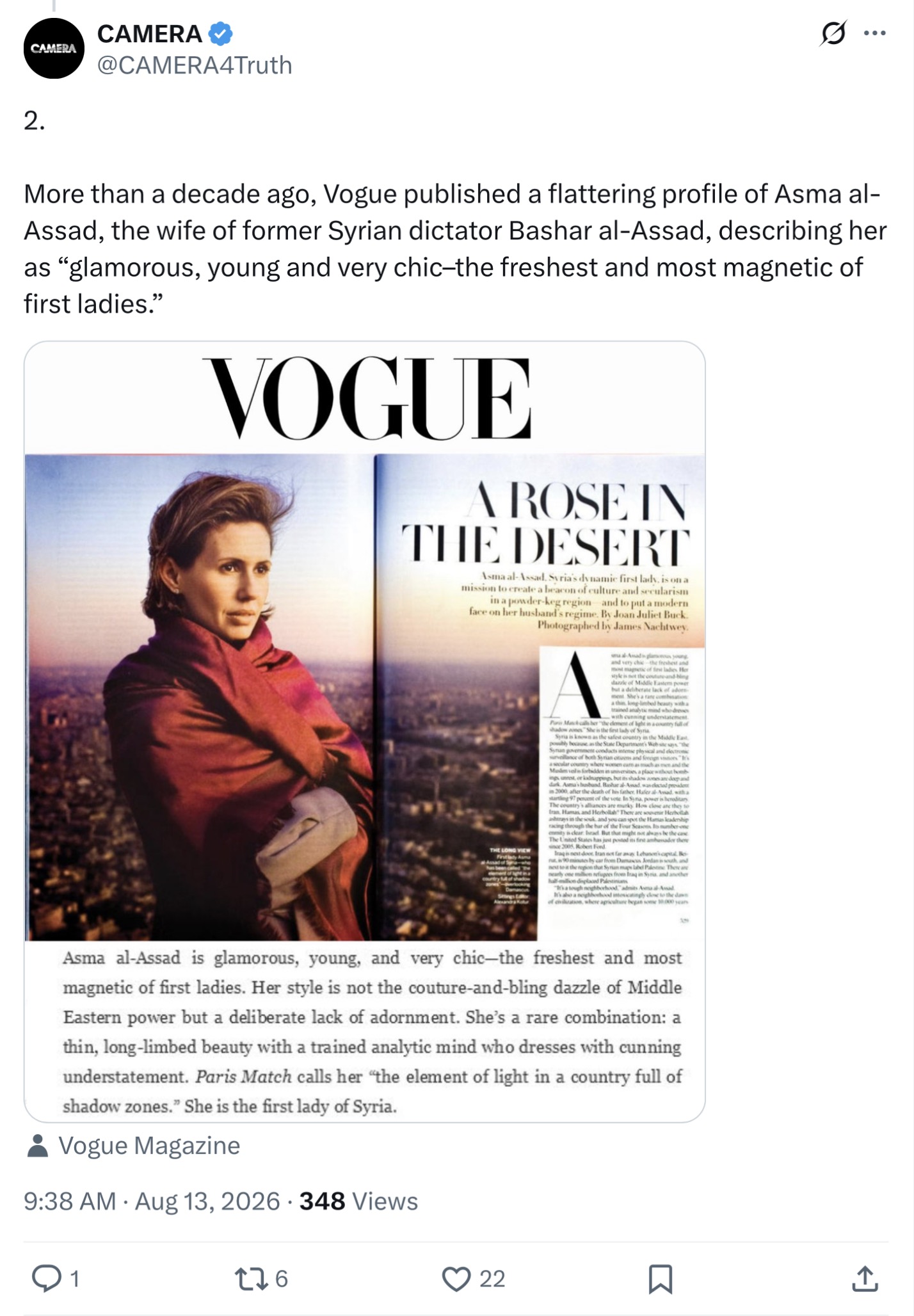
When even the anti-Israel Mamdani administration is hesitant about mainstreaming an (alleged) antisemite, attempting to rehabilitate Galliano may have been a step too far for someone whose magazine previously referred to Mrs. Bashar al-Assad as a “Rose in the Desert:”
Screenshot
SAD, BUT HANS IS PROBABLY CORRECT:
Remember, whenever you read anything in the Wall Street Journal about China, you should assume it came straight from the Chinese Communist Party’s propaganda office. https://t.co/ogyGkpEoqu
I come not to praise the ’80s, but to bury Ryan Reynolds’ stupid, ignorant, and frankly Canadian complaints about the most awesome decade ever.
Talking to Variety to promote Mayday — a watch-it-once-and-forget-it flick — Reynolds didn’t just diss the ’80s; he went off. And he was just so wrong.
“The ’80s was a brutal, brutal time for people,” Reynolds whined. “It was a f***ing mess and people forget that. It was a tremendous strife. Socio political tensions everywhere. We were still pretty fresh off a Cuban missile crisis, which was only 15-20 years before. It’s a tumultuous period, but you look back at it now and you’re like, ‘Oh, yeah. Top Gun. Cocaine!’ Like, ‘No!’ It was really scary.”
Gentle reader, this effrontery will not stand.
So much more at the link.
BAD NEWS: A few weeks ago, the California Legislature voted to put a new referendum aimed at gutting Proposition 209 on the ballot. I am obviously going to have to fight these blasted things for the rest of my life. The only good thing is that it won’t be on the ballot until November of 2028. Read about it in my Daily Wire essay.
I’ll write more about it here soon. Right now I have to finish up another project–a lawsuit–that I hope will be better news.
Plus my book is coming out soon … more on that later too.
Did people forget about the southern poverty law center scandal already where the dems paid the KKK and other extremists groups? https://t.co/KaYTxfivAH
FINALLY, A “WE ONLY HAVE FIVE YEARS TO SAVE THE WORLD AS WE KNOW IT” WARNING THAT MIGHT ACTUALLY COME TRUE:
What this ultimately means is that Los Angeles has five years to prove it really wants movies made here. Otherwise, everyone (and I mean everyone) is moving out. Remove oppressive regulations, fees, and bureaucracy and make it cheaper to do business in Hollywood. https://t.co/IvZSe0gdIm
China is not merely another authoritarian country. It possesses nuclear weapons, the world’s largest standing military by personnel, enormous security and intelligence organizations, advanced biological laboratories, vast state enterprises, major financial institutions and supply chains embedded throughout the world economy.
The collapse of central authority could therefore create simultaneous military, financial, humanitarian, political and proliferation crises.
Who controls the nuclear arsenal? Who commands the People’s Liberation Army? What becomes of the People’s Armed Police, the militia, the Ministry of State Security and the vast domestic surveillance apparatus? Who secures dangerous biological facilities? Who prevents provincial military commanders or security chiefs from becoming warlords? What happens to the renminbi, China’s banks, sovereign obligations, state enterprises, foreign reserves and trillions of dollars of domestic assets?
From there, things get dicey.
InstaPundit is a participant in the Amazon Services LLC Associates Program, an affiliate advertising program designed to provide a
means for sites to earn advertising fees by advertising and linking to Amazon.com.