WHO DIED AND MADE WOMEN G-D? The Mommy Standard.
September 18, 2026
THE GODS OF THE COPYBOOK HEADINGS IS THE UNOFFICIAL SIGN AND COUNTERSIGN OF MY BLOG: Have You Ever Kippled?
September 17, 2026
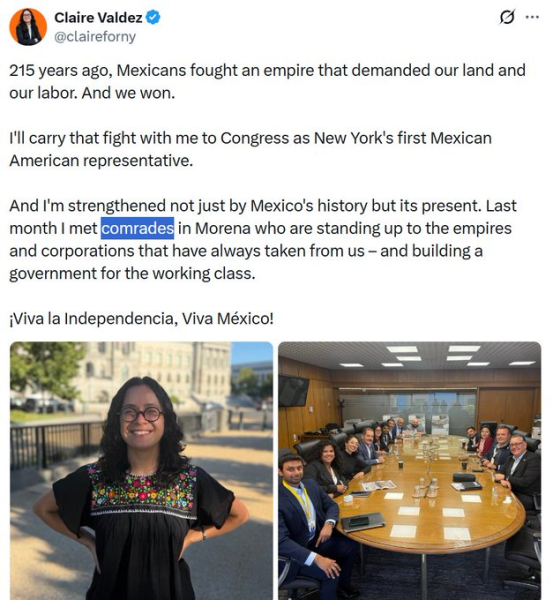
NARRATOR: CLAIRE VALDEZ WAS BORN IN TEXAS:
THIS EXAMPLE OF THE IRANIAN REGIME’S BARBARISM DESERVES MUCH MORE ATTENTION THAN ITS BEEN GETTING: Iran’s Expanding Campaign Against Jewish Targets Outside Israel
OPEN THREAD: One night in this place makes a hard man humble. I can sense the Devil walking next to me.
JUSTICE IN AMERICA: Lone Holdout Juror in Lindsay Clancy Case Gets a Lawyer — and a Safe House.
PROFESSOR CARRINGTON, CALL YOUR OFFICE: Space weather caused a 16-minute train delay in 1848: ‘Our research has a hint of a detective story.’
MAKE THE LEFT PLAY BY ITS OWN RULES: Karol Markowicz: Macklemore Is No Free-Speech Martyr: Jewish artists were being canceled long before the controversy over the rapper’s anti-Israel rant.
The scale of the backlash to his concert comments was surprising. Concerts have long been a breeding ground for a self-important musician to deliver his thoughts on the issues of the day. It was boring. It was tedious. It was expected.
So when artist Pink shared a long condemning message pointing out that “Jewish fans bought tickets to see Ed Sheeran sing last night in NJ, not to be ambushed by Macklemore’s anti-Israel propaganda,” it felt new. When Robert Kraft, owner of the New England Patriots, said the politicized performance wouldn’t be welcome at his Gillette Stadium in Massachusetts, one of Mr. Sheeran’s tour stops, it wasn’t the same old hand-wringing with no action. Few expected that Macklemore would end up canceled from the remaining tour dates. That’s not normally what happens to activists on the left. . . .
It turns out it works both ways. The uproar from people at the Ed Sheeran show, including from non-Jews, put Macklemore’s spectacle front and center. It had been the left’s game and Macklemore was the first time they had prominently lost at it.
The complaints now are about “free speech.” But no one cared about that when Jewish singers, comedians, artists and authors had their speech shut down. The publishing world, in particular, has gotten so impossible for Jewish authors that new Jewish imprints have become necessary for Jewish authors to get published at all.
It isn’t free speech the left is now demanding for Macklemore. It’s free speech for its side only. That’s something our culture can no longer abide.
Sauce for the goose.
I DON’T LIKE TICKS: New Tick-Borne Virus May Explain Mysterious Cases of Severe Illness.
MAGA: Americans are richer than ever — and poverty hits an all-time low. “The good news came despite a wild series of economic headlines in the US and beyond, touching on everything from tariffs to international conflicts.”
VENERABLE: Lockheed hopes to sell a new F-16 to U.S. Air Force.
Lockheed Martin is pitching the U.S. Air Force on a new version of the F-16 fighter, designated the F-16G, as a way to replace aging Fighting Falcons faster than the F-35 production line can keep up.
Multiple people familiar with the aircraft told Aviation Week that the F-16G builds on the current Block 70 F-16, Lockheed’s newest production version, and would add conformal fuel tanks, 600-gallon wing tanks, an infrared search and track pod, a Sniper targeting pod and a drag chute. Those additions would extend the jet’s range and give it added sensor capability compared with earlier F-16 models still flying in Air Force squadrons.
The idea of buying new F-16s to fill out the fighter fleet is not new. Then-Air Force Assistant Secretary for Acquisition Will Roper raised the option back in 2021, pointing to the active F-16 production line in Greenville, South Carolina, as a way to add capacity while the F-35 program worked through its own delivery pace. Lockheed builds F-16s and F-35s at separate facilities, but the F-35’s more complex production process has left the Air Force short of new airframes to replace F-16s reaching the end of their service lives.
Why not? The heavily upgraded F-15EX Eagle II has proven to be a real winner, filling in the gaps of our unpardonably small F-22 fleet.
INFLATION, GAS PRICES, AND THE MAINSTREAM MEDIA:
Stocks at record highs.
GDP at 5.1%.
Real incomes at record highs.
Poverty at record lows.
Food inflation below 20 year average.
Factories at 82% capacity.
Standard of living best ever.
Crime at record lows.Trump approval on the economy – record lows.
What am I missing?
— Bill Mitchell (@mitchellvii) September 17, 2026
PAST PERFORMANCE IS NO GUARANTEE OF FUTURE RESULTS: Trump ‘I did that’ stickers pop up on gas pumps, four years after Biden got the same treatment.
I’m so old, I can remember Obama’s soon-to-be energy secretary telling the Wall Street Journal in the fall of 2008 that “Somehow we have to figure out how to boost the price of gasoline to the levels in Europe,” and the LA Times extolling “The joy of $8 gas.”
But then, I can also remember when candidate Bill Clinton savaged George H.W. Bush for raising taxes, after Clinton’s fellow Democrats begged Papa Bush to raise taxes.
ANSWERING THE IMPORTANT QUESTIONS: 2026 Porsche Panamera GTS First Test: The V-8 Four-Door Porsche Still Has a Point.
CHRISTIAN TOTO: ‘Run Hide Fight: Infidels’ – ‘Red Dawn’ for Academia’s Insane Woke Culture.
If filmmakers won’t tackle the woke Left, Ben Shapiro’s team will step up via films like “Run Hide Fight: Infidels.”
The action thriller takes meaty swipes at:
Woke college administrators
Campus radicals
Wishy-washy deans
Triggered snowflakes
And, of course, the dangers of radical IslamThe latter is center stage with “Run Hide Fight: Infidels,” a spiritual sequel to the superior 2020 film “Run Hide Fight.” Director Kyle Rankin returns to poke progressive Hollywood in the eye.
That’s the good news.
The film’s satirical formula falters after a spell, becoming a generic shoot ‘em up that doesn’t take full advantage of what came before it.
Sounds like a bit of a mixed bag. But it has all the right people’s panties wadded, so I look forward to seeing it.
EMMY AWARDS’ AUDIENCE BECOMING INCREASINGLY MORE SELECTIVE: Emmys Ratings Fall as Awards Show Eyes End to Its Broadcast Era.
Monday’s Emmy Awards, aired Monday by NBC, posted a 9% decline in audience from the show’s 2025 viewership, marking what appears to be the end of the Emmys broadcast-network era.
According to Nielsen’s preliminary audience estimate, 6.7 million viewers watched the Emmys this year, down from the 7.4 million who tuned in last year.
While the viewership of awards shows has been treading downward in recent years, several factors complicate efforts to draw solid conclusions about the cause of this year’s drop in Emmys audience from 2025:
* * * * * * * *
If the Emmys do, indeed, move to Amazon, they will join other awards programs – such as the Oscars, SAG-AFTRA’s Actor Awards and the Academy of Country Music (ACM) Awards – who have signed deals to move to a streaming service.
One advantage of signing a multi-year deal with a single outlet is that the platform would have more incentive to promote the show, since doing so won’t benefit the competitor who gets the Emmys the next year.
So a streaming platform will be hosting an awards show dedicated to promoting network and cable TV shows? And note that the movie industry’s Academy Awards are moving to YouTube, the original streaming platform, in a couple of years as well: Failing Oscars Demoted to YouTube. “Starting in 2029, the irrelevant Oscars will have its annual irrelevant Academy Awards show broadcast on — lol — YouTube.”
As Steve wrote earlier today: Say Goodbye to Hollywood… If It Even Exists Anymore.
AMERICA’S NEWSPAPER OF RECORD:
Macklemore Performs Concert In Gaza And Oh No! They've Thrown Him Off A Roof https://t.co/C3l9qDT5JY
— The Babylon Bee (@TheBabylonBee) September 16, 2026
LIMITED TIME DEAL: ALORAIR Air Scrubber with 3 Stage Filtration, Clean Shield Hepa 550, Blue. #CommissionEarned
VDH: Iran, the Midterms, and October Surprises.
The theocracy is now vastly diminished after months of Israeli and American bombing and crushing new sanctions. Moreover, the desperate regime has continued to murder dissidents in the months since the failed uprising of January 2026.
In sum, the Iranian conflict is one of the strangest wars of the modern age.
The Iranian regime has suffered terrible material and financial damage.
Its nuclear program is likely in ruins, and its original command-and-control leadership has been destroyed.
The people detest it. The Kurdish minority loathes it. Conditions on the ground are dire, with terrible shortages of food, medicine, and fuel.
The resistance may sense that the Trump administration would double down on kinetic force to finish off the wounded regime if a mass popular uprising emerged and needed support from the air.
Taken together, these possible October surprises before the November midterms could make the next 50 days the most volatile in modern memory.
Trump could well be facing domestic warfare as well next year: Jeffries has not ‘ruled anything out’ on impeaching Trump if Democrats win.
I LOVE A STORY WITH A HAPPY ENDING: Orland Park, IL Gas Station Stickup Man Learns the Victim Gets a Vote, Too.
THE NEW SPACE RACE: The battlefield now extends all the way to the moon, U.S. military’s highest-ranking officer says.
“Today’s modern battlefield operates from the seabed to cislunar space,” Gen. Dan Caine, the chairman of the Joint Chiefs of Staff, said Wednesday (Sept. 16) during a keynote address at the Air & Space Forces Association’s Air, Space & Cyber Conference in National Harbor, Maryland.
Cislunar space extends from Earth all the way out to the orbit of the moon and includes the lunar surface. For several years now, military officials have been stressing the strategic importance of this huge region, which could get quite a bit busier in the next decade or so.
For example, both the United States and China plan to build bases near the moon’s south pole, which is thought to harbor large amounts of water ice. Winning this new moon race is critical, U.S. officials have stressed, because whoever does so will be able to establish norms of behavior on and around Earth’s nearest neighbor.
And as Robert Heinlein taught us, the Moon is the ultimate high ground.