OPEN THREAD: Ring out the weekend.
September 20, 2026
COMING SOON TO A SCREEN NEAR YOU: MORE AGE GATES, MORE ID CHECKS, LESS ANONYMITY. Europe is considering sweeping new limits on minors’ access to social media and AI. See what that means for your rights in this week’s update.
“WHEN THEY GET IN TROUBLE, THEY SEND FOR THE SONS OF BITCHES.”
And just like that, white men are back in adverts. pic.twitter.com/Md1JCCTv6u
— Tommy Robinson 🇬🇧 (@TRobinsonNewEra) September 20, 2026
The quote is attributed to Admiral Ernest King, right after Pearl Harbor. But I predict that the necessary demographics in Europe will be slow to answer the call after the last decade.
LOL, THOMAS MASSIE: Thomas Massie Just Filed 8 Articles of Impeachment Against Pete Hegseth.
I hope some Republican House member responds by moving for a vote to expel Massie. Both are equally likely to happen.
POKER WARS: Philip Guitar Talks ‘Poker Wars,’ the Bloody Battles that led to the World Series of Poker.
My latest, over at Ed Driscoll.com.

FASTER, PLEASE:
Doomers once again hardest hit…. https://t.co/ShB8NzALXq
— unseen1 (@unseen1_unseen) September 20, 2026
BUCKLE UP:
I will spell this out, since OSINTTechnical did not
This action should be considered a war warning.
There is no reason for Russia to do it unless they are are planning secret military movements. https://t.co/d2rnGUmWso
— Eric S. Raymond (@esrtweet) September 20, 2026
INTRODUCING THE PEOPLE ANTHROPIC WANTS IN CHARGE OF REGULATING AI ON YOUR BEHALF:
Anthropic’s CEO wants America’s AI labs to embed “independent” groups like METR inside them to enforce “alignment.”
The money trail runs through a shadowy leftist NGO same small network.
This is another battle in our war against leftist censorship NGOs.🧵 pic.twitter.com/u3GvBH3CQW
— Eric Schmitt (@Eric_Schmitt) September 20, 2026
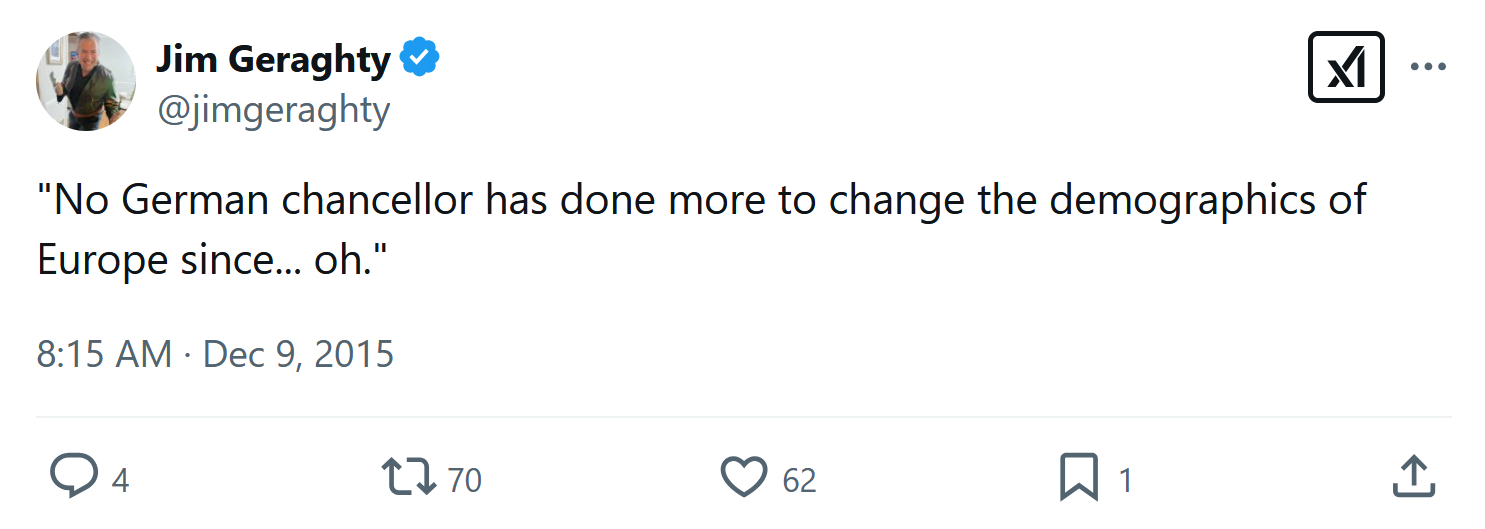
ANGELA MERKEL’S TENURE “REPRESENTED THE HIGH POINT OF POSTWAR EUROPEAN EXTREMISM.”
In a brilliant essay in The Sunday Times, Matthew Syed writes the following: “If extremism is defined as acting out of proportion with context, history or consent, I suggest Merkel’s tenure represented the high point of postwar European extremism.”
I agree with Syed’s analysis.… pic.twitter.com/dCE48mAcpv
— Henrik Dahl (@SociologenHD) September 20, 2026
Why, it’s as if:
CAMPUS VIOLENCE IS LOOKING LESS LEFT VS. RIGHT AND MORE MEN VS. WOMEN. FIRE’s latest data shows ideology is becoming a weaker predictor of support for violence against speakers. See the stats in this week’s update.
CRICKETS:
Turkey raided gay bars and LGBTQ groups this week and jailed activists. (BBC, Reuters, & AP.) Same-sex relations aren’t even a crime there.
HRC, GLAAD, and Stonewall have not written a word. HRC spent the week posting Senate endorsements.
A week of mass arrests. Silence.
— Peter Boghossian (@peterboghossian) September 20, 2026
If you needed more evidence that LGBTQ+ organizations are just Marxist fronts that care a lot more about the revolution than any actual LGBTQ+ person, here you go.
DISPATCHES FROM THE EDUCATION APOCALYPSE: Nikole Hannah-Jones Just Wrote the Best Case for School Choice She’ll Ever Publish.
The neighborhood school system in New York is atrocious. She knew this before sending her child to one. This is a mother who visited the cafeteria herself, who pulled fighting kids apart, who sat down and read through the ungraded homework page by page. She saw it happen, in real time, year after year. And she kept her child in that system anyway, all to make a point.
Middle school didn’t fix it. At Urban Assembly Unison, the school eliminated homework outright and adopted an “Algebra for All” policy that pushed advanced math onto students, Najya included, before they’d mastered the material underneath it. An outside tutor later found Najya hadn’t even mastered long division or fractions, the building blocks the algebra was supposed to rest on. Najya got A’s at Unison. She also, by her own account years later, “didn’t know anything.”
Hannah-Jones wants readers to see this as evidence of a broken, racially rigged system that owes her daughter something it never delivered. Some of what she documents is real: underfunded schools, high teacher turnover in high-poverty buildings, and the well-established fact that screened, selective public schools skew whiter and wealthier in a city like New York. That part of the argument isn’t fiction. It’s also not the part that determined what happened to Najya.
What determined what happened to Najya is that her parents, fully informed and financiallyN able to choose otherwise, chose a demonstrably struggling school for seven consecutive years, and admit, in the mother’s own essay, to reading every warning sign along the way.
Then something remarkable happens in the piece, and it’s the part that should have led the article: as an eighth grader, Najya finally got the freedom to choose her own high school, guided by her own criteria rather than her mother’s cause. She picked a rigorous, selective school her mother had spent a career arguing against.
Related: Question asked and answered:
NHJ and her husband intentionally sent their daughter to a low-income black school.
When her daughter said something about it, NHJ first tried to say her school wasn’t that bad: pic.twitter.com/VXhdR5QqI1
— Steve McGuire (@sfmcguire79) September 20, 2026
UPDATE:
"We are more than 150 years past the end of slavery in America, and yet Nikole Hannah-Jones is more obsessed with race than any of the Confederate leaders whose likenesses are carved upon the side of Stone Mountain."https://t.co/o5VVzogSHq pic.twitter.com/oZ07KVvqrE
— The Patriarch Tree (@PatriarchTree) September 20, 2026
MORE:
I have some thoughts!
Nikole Hannah-Jones interviewed me at the height of woke-1 to champion and virtue signal her “fight for every black child” and disparage and dismiss my fight for all NYC public school students to enjoy the rising tide that lifts all boats of academic rigor… https://t.co/3gePQnlB2d
— Maud Maron (@MaudMaron) September 20, 2026
Exit quote: “You’re welcome Nikole. Your daughter’s chosen high school would not exist but for parents like me who fought so hard to keep screened schools.”
OPPORTUNITY KNOCKS: Avio seeks to cash in on Falcon 9 retreat.
Italian launch services provider Avio has seen an influx of customers who were unable to secure launch opportunities with SpaceX, European Spaceflight reports. “I can tell you SpaceX has already gone captive because we have a whole bunch of customers coming to us and saying, ‘Oh my God, can you fly us?’” Avio CEO Giulio Ranzo said during the company’s September 10 earnings call. In recent months, SpaceX told multiple prospective customers that it was no longer accepting new orders for commercial Falcon 9 launches.
Europe’s answer to this, a subsidy? … According to Ranzo, some customers who had been turned away by SpaceX used the International Space Summit in Paris last week to lobby European institutions for financial support that would help offset the higher cost of launching with a European provider. Although prices for Avio’s Vega C rocket are not public, it likely costs about $60 million for a launch on the solid-fueled rocket. In our view, subsidizing launches on expendable launch technology is a poor plan. The continent should increase investment in developers of more competitively priced rockets.
Doing things the same way but with subsidies is what they do in Europe instead of innovate.
EAGLES-TITANS GAME TURF WAS 157 DEGREES, PER FOX TELEVISION BROADCAST:
A heat advisory and temperatures in the mid-90s in Nashville had players from the Tennessee Titans and Philadelphia Eagles pulling out all the stops to keep themselves — and their cleats — cool on Sunday.
The Fox broadcast reported the Nissan Stadium turf was 157 degrees in the third quarter. Cameras showed Titans players getting their cleats sprayed with water on the sideline, a strategy the team may have prepared for after playing in similar temperatures in its Week 1 loss to the New York Jets. The Eagles eventually won Sunday’s game vs. the Titans 24-20.
When in Nashville… 😂 pic.twitter.com/NWepuwjpkP
— FOX Sports: NFL (@NFLonFOX) September 20, 2026
Titans safety Amani Hooker told team writer Jim Wyatt that his cleats melted during the season opener.
“It was hot, it was really hot,” Hooker said. “My cleats actually had melted; the midsoles melted completely off, so I had to change cleats right before halftime.”
Roger Goodell wants to make the NFL a global concern, with games this season locations such as Australia, Brazil, London and Paris. Apparently he wants to go interplanetary as well, what with today’s game having been played on the surface of Venus.
TRUMP STARTED A DEREGULATORY REVOLUTION, AND IT IS GLORIOUS:
Trump doesn’t get the credit he deserves. The media is absolute junk for not covering the real story and why America is so resilient.
Once this Iran bullshit is over prices of goods, inflation and energy cost will collapse.
— Agent (@CallThisAgent) September 20, 2026
LIMITED TIME DEAL: roborock Qrevo CurvX Robot Vacuum and Mop. #CommissionEarned
SPACE: ‘We are on our way to groundbreaking science’: Stars turn neon-green in first test image from NASA’s Roman telescope. “The telescope, which launched to space on Aug. 30, is partway through a months-long commissioning process, with NASA scientists testing and tuning each of the spacecraft’s instruments as it undertakes a million-mile (1.6 million kilometers) journey to Lagrange point L2 — an orbital ‘parking spot’ where the competing gravity of Earth and the sun will hold Roman in place, alongside the James Webb Space Telescope (JWST) and other scientific spacecraft.”
Best part: “But in a final piece of good news, that 10-year mission now looks likely to double. According to NASA, a successful thruster burn (combined with bonus fuel loaded onto the spacecraft at launch) means that Roman may be looking at 22 years worth of power rather than 10.”
Bravo to the SpaceX launch team and Falcon Heavy.
I’VE READ THIS STORY BEFORE BUT IT NEVER GETS OLD:
Bill Gates once came to Giga Texas and told Elon that a long-range electric semi truck was impossible and it doesn't work
Elon’s response was:
“We literally have them. Drive one yourself. Pepsi is using them right now”Bill Gates still kept insisting:
“No, it doesn’t work”And…
— X Freeze (@XFreeze) September 20, 2026
More:
Elon’s response was: “We literally have them. Drive one yourself. Pepsi is using them right now.”
Bill Gates still kept insisting: “No, it doesn’t work.”
And this is the funniest part.
Elon asked him what exactly about the engineering made the Tesla Semi “impossible.”
Gates couldn’t really explain the engineering behind his claim.
Fast forward to today:
• Tesla Semi production has started
• 500-mile estimated range
• Einride plans to add 500 Semis
• 330+ Semis are already reserved around one California charging depot
• Tesla is rapidly expanding Megacharging infrastructure
• And Semi is now moving toward EuropeElon literally built the entire truck and proved it in the real world
Imagine being that confidently wrong about the technology while still getting treated as a climate expert.
“Always listen to experts,” the wise man once said. “They’ll tell you what can’t be done and why. Then do it!”
MY BIRTHDAY GIFT WAS MACKLEMORE, ED SHEERAN, AND THE STREISAND EFFECT. I WOULD’VE PREFERRED SOCKS. I joined Jake Tapper to explain why the controversy isn’t simply “free speech” versus “censorship” and why trying to suppress political speech so often makes it louder. See my full interview with Jake Tapper in this week’s update.
LIMITED TIME DEAL: Seat Cushion for Tailbone & Sciatica Pain Relief. #CommissionEarned
DON’T WRITE MAJOR LEGISLATION IN A PANIC:
The United States has been leaping from one moral panic to the next: Black Lives Matter, MeToo, George Floyd, and now data centers plus the specter of AI-driven human extinction. In every case a genuine problem exists, but the threat is inflated out of all proportion and the…
— Timur Kuran (@timurkuran) September 20, 2026
More:
In every case a genuine problem exists, but the threat is inflated out of all proportion and the costs of overreaction are overlooked. The resulting hysteria blocks clear thinking and closes off rational discussion. Consequently, individuals never notice that self-appointed experts are distorting the facts for their own gain.
Companies with billions in AI stakes are perfectly capable of staging “rogue LLM” incidents to stampede politicians into regulation that keeps out competitors or simply reduces their own liability.
Previous panics have already damaged trust in institutions and among ourselves. They have also intensified the political polarization that now endangers American democracy. We should resist the current panic rather than feed it. The costs of getting this one wrong dwarf those of the last several.
PATRIOT Act, CARES Act, TARP, etc.
AMERICA’S NEWSPAPER OF RECORD:
New Underground Railroad Established To Help Lone Black Juror Escape From Angry White Liberals In The North https://t.co/hvTn8XFzgQ
— The Babylon Bee (@TheBabylonBee) September 18, 2026
YOU CAN’T MAKE THIS STUFF UP: Minnesota anti-ICE relief fund shut down after 2/3 of applicants flagged over fraud. “Hennepin County, Minnesota, approved $2 million in funding to local businesses in response to the Trump administration’s immigration enforcement operation, Operation Metro Surge. The county received over 300 applications and ended up distributing $500,000 to 82 applicants. However, over 200 applications were flagged for potential fraud, according to KARE 11.”