YES. NEXT QUESTION? Are Too Many Americans Taking Antidepressants?
September 12, 2026
MICROBIOME NEWS: Mulberry Shows Surprising Effects on Gut Bacteria and Metabolism.
FOLLOW THE SCIENCE: Covid 19: They’ve Learned Nothing — Because That Would Expose Too Much. “Worse, they may not want to learn. The Inquiry’s structure, its analytical frame, even its carefully curated narrative all point in the same direction: away from the possibility that Britain’s pandemic response was fundamentally misguided, and toward the politically safer claim that ministers simply ‘acted too late.'”
HISTORY:
Poland and the Winged Hussars saved Vienna on this day in 1683 from the Ottoman siege.
It was the largest recorded cavalry charge in history with 20,000 horseman thundering down to save the city! pic.twitter.com/CAhDySlztG
— Today in History (@TodayinHistory) September 12, 2026
THIS IS CNN:
Yeah, it's important that you know it was a Black woman found hanging, but unimportant that the suspect arrested for the murder was a Black man. That's not pertinent to the story I guess. 🤷But then again, I'm not a journalist.
— Garry Wentz (@WentzGarry) September 12, 2026
And they’re not alone:
AOC and Ayanna Pressley said this woman's murder was a case of a hate crime lynching.
Here is the mugshot of her alleged killer, 51-year-old Jarques Ratliff. https://t.co/dbAQ0Sk2MP pic.twitter.com/GpUNUsL9fd
— Chuck Ross (@ChuckRossDC) September 12, 2026
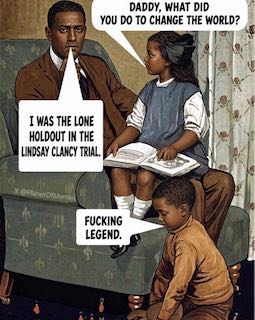
Evergreen:
Fact. pic.twitter.com/XQGhkTTZsX
— Planet Of Memes (@PlanetOfMemes) September 11, 2026
LEE SMITH: 9/11 Never Happened.
Twenty-five years later, the legacy of 9/11 is that there was no 9/11.
Commemorations this week hold that the deadliest attack on the U.S. mainland forever changed the way we live. And that’s true if we mean that for the past 25 years Americans have lived in a collective fugue state from which there seems no exit.
The issue isn’t that nearly a third of the country was born after the attacks or that foreign intelligence services push 9/11 lies into our social media ecosystem. The conspiracy theorists are more shrill a quarter of a century on precisely because our memories of the day, and our reactions to it, have been redirected and erased.
There was never any kind of cover-up; there were no “dancing Israelis” who secretly directed Arab terrorists into the Twin Towers to get American boys to die in the Middle East on behalf of Israel; and there was no controlled demolition of the towers as part of a false flag operation to drive an angry nation to war in the Middle East.
Rather, it was more like the opposite: Elites across the political spectrum blunted the rage of a wounded nation determined to avenge its dead.
By the time of the attacks, New York had been in the crosshairs of Muslim terrorists for decades. The city is the world capital of finance, media, advertising, publishing, and culture, from painting to theater. And much of its success was thanks to the waves of Jewish immigrants that started arriving in the middle of the 19th century. With the United States’ victory in World War II, the human capital that the city had accumulated and augmented for a century turned New York into human history’s new center of gravity.
The serial efforts to bring the city to its knees would require making Western civilization doubt its strength, virtue, and purpose. And how we remember the attacks is proof that these efforts worked.
The whitewash of Sep. 11 was conducted in full view of the public and started almost immediately after the attacks, while aid workers at the World Trade Center were still sorting through the rubble and ashes.
Read the whole thing.
UPDATE:
I feel that the 25th anniversary of 9/11 has caused a critical mass of Americans to reach an inflection point on their understanding of that event.
We are starting to realize that we lost the Global War on Terror. We did not lose it on military grounds. We lost it on spiritual…
— Cynical Publius (@CynicalPublius) September 12, 2026
MORE: “The Constitution is not a suicide pact and no one has a constitutional right to use our freedoms against us by working to overthrow the U.S. with a totalitarian political system in the name of a faith.”
The rational domestic response to 9/11 would have been for the federal government to engage in an extensive study of Islam, Sharia, the ideology and practices of both violent jihadist organizations and "civilizational jihadist" organizations, and then to calibrate a… pic.twitter.com/zgjKbqcF9C
— Benjamin Weingarten (@bhweingarten) September 10, 2026
UPGRADE YOUR COMPUTER: HP OmniBook 3 17.3 inch Laptop PC. #CommissionEarned
IT’S ALWAYS HILARIOUS WHEN LEFTISTS START INVOKING GOD: Beto Talarico Was Outraged That Texas ‘Ignored God’s Messengers’ and Refused to Limit Gun Rights.
LEFTISM IS AN IDEOLOGY DESIGNED TO LET BAD PEOPLE AND LOSERS FEEL BETTER ABOUT THEMSELVES:
Older Conservatives have no idea that this is what every single Right-wing Millennial and Zoomer experience when they interact with anyone of a similar age to them on the Left.
We don’t see Leftists as union members, college professors, or Hollywood directors. We see them in the… https://t.co/QBnkJlJZkM pic.twitter.com/ojEpd2Pmme
— Christian Heiens 🏛 (@ChristianHeiens) January 6, 2026
GET YOUR VITAMINS: Ensure Max Protein Milk Chocolate Shake. #CommissionEarned
AMERICA’S NEWSPAPER OF RECORD:
Mamdani Lays Wreath At Tomb Of The Unknown Hijacker https://t.co/uDqbIs7Xs6
— The Babylon Bee (@TheBabylonBee) September 11, 2026
YOU MAY NOT BE INTERESTED IN THE GLEICHSCHALTUNG, BUT THE GLEICHSCHALTUNG IS INTERESTED IN YOU — AND YOUR KIDS: Parents Can’t Escape Washington’s Transgender Policies by Changing Schools, Supreme Court Brief Argues.
A WORTHY CAUSE:
**Decided to launch it. This guy might have his problems, but the hysterical MSM doxxing makes this a WORTHY CAUSE!
Let's see if a working guy who showed up for a major trial and did what 78% of people think is the right thing can outpace Karmelo…Luigi…and Clancy herself.…
— Wilfred Reilly (@wil_da_beast630) September 12, 2026
Here’s here’s the GiveSendGo link.
THEY’RE ALWAYS IN THE LAST PLACE YOU LOOK: Backyard treasure hunt: homeowner digging a patio unearths 1,000-year-old Viking Treasure.
CHRISTIAN TOTO: Bill Maher to Macklemore ‘You Don’t Know S***.’
“[The 9/11 terrorists] weren’t cowards. But I’ll tell you who is. Democratic party politicians, and I’ll tell you why. Because nowhere has this moral confusion become more obvious than in a place called Gaza, a little strip of land that was not part of the original Israel but which they won in a war launched against them, but then gave back as a peace gesture,” Maher said. “Did they tell you that part on TikTok, kids?”
“The people who run Gaza, Hamas, who you celebrate as a liberation movement but are really a terrorist mafia gang just like the one that terrorizes Haiti, only ever used it to stage attacks on Israel,” he said.
He was just warming up.
Next, he attacked (not by name) celebrities like Mark Ruffalo, Javier Bardem and Hannah Einbinder who relentlessly attack Israel and praise the Palestinian cause.
“I think Macklemore spoke for all clueless celebrities when he said, ‘I know enough to know this is a genocide. Actually, you don’t know s***.”
Macklemore recently lectured the crowd at an Ed Sheeran concert with his pro-Palestinian talking points, drawing outrage from select Jewish groups.
“It’s not a genocide. It’s a counter-attack in a war, a war that’s been waged on Israel since 1948 based on the ridiculous premise that Jews don’t belong in the one place on earth they are indigenous,” he said. “Hey geniuses, they’re the Indians in this scenario.”
At RedState, Nick Arama adds: Bill Maher Decimates the Media, Radical Islam, and the Left in a Brilliant 9/11 Take.
So much has changed since 9/11, he remarked. “For example, back then, we were against the terrorists,” he said. He went on to note how the liberal media are too timid now even to use the “T” word, or call them what they are.
“Really? We can’t anymore just say out loud who the bad guys were that morning? Those 19 hijackers? They shared something. Oh, let’s call it a worldview. And it wasn’t astrology. But somehow, over time, we’ve decided not to harp on that, the whole business about who wanted us dead and why. Let’s not put a name on it.”
He referenced how Canada’s “state TV” – the Canadian Broadcasting Corporation (CBC) – told its people not to refer to the 9/11 attacks as “terrorist attacks.” “What should we call it then?” he asked. “Unruly passenger? A wrong turn taken at the Chrysler Building?” He noted how the BBC said using the term “terrorist” could be a barrier to understanding. “You know what’s really a barrier to understanding?” Maher stated. “Lying.”
It is a clash of civilizations, he asserted, between radical Islamism and Western civilization. Then he chastised liberals who wound up on the wrong side of that equation, on “their side.”
“One in 5 young Americans has a positive view of Osama Bin Laden. He’s like Luigi Mangione in a turban!” Maher snarked.
Maher also chastised the people who thought the worst thing was that “innocent Muslims came under suspicion.” No, he said, the worst thing was that nearly 3,000 people were killed that day.
Still licking their chops over the outcome of the 2000 election, there were a fair amount of leftists in America who held those views immediately after 9/11, but in the pre-Twitter and Facebook world of the early naughts, they stewed on their own forums and blogs. In 2004, Charles Krauthammer coined “the Pressure Cooker Theory of Hydraulic Release” to explain why the left exploded after temporarily maintaining a veneer of civility:
The hostility, resentment, envy and disdain, all superheated in Florida, were not permitted their natural discharge. Came Sept. 11 and a lid was forced down. How can you seek revenge for a stolen election by a nitwit usurper when all of a sudden we are at war and the people, bless them, are rallying around the flag and hailing the commander in chief? With Bush riding high in the polls, with flags flying from pickup trucks (many of the flags, according to Howard Dean, Confederate), the president was untouchable.
The Democrats fell unnaturally silent. For two long, agonizing years, they had to stifle and suppress. It was the most serious case of repression since Freud’s Anna O. went limp. The forced deference nearly killed them. And then, providentially, they were saved. The clouds parted and bad news rained down like manna: WMDs, Abu Ghraib, Richard Clarke, Paul O’Neill, Joe Wilson and, most important, continued fighting in Iraq.
With the president stripped of his halo, his ratings went down. The spell was broken. He was finally, once again, human and vulnerable. With immense relief, the critics let loose.
The result has been volcanic. The subject of one prominent new novel is whether George W. Bush should be assassinated. This is all quite unhinged. Good God. What if Bush is reelected? If they lose to him again, Democrats will need more than just consolation. They’ll need therapy.
Plus ça change, plus c’est la même chose.
DISPATCHES FROM THE CERULEAN BLUE STATES: Anna Wintour’s Greenwich Village block overrun by homeless encampments, notorious vagrant named Tiger.
This block is in vogue with bums!
Anna Wintour’s posh Greenwich Village block has become a haven for the homeless who turned it into their own outdoor flophouse, frustrated residents and workers told The Post.
At least five other vagrants have moved onto Sullivan Street between East Houston and Bleecker streets since The Post revealed its dodgiest denizen: a pot-puffing, booze-swigging, twerking vagrant named “Tiger,” for the striped orange tail secured to his rump.
The motley crew has assembled a hodgepodge of chairs, storage containers, books, decorative planters, side tables and bedding in front of shuttered businesses in and around the same stretch where the legendary Vogue editor lives in her $11.5 million townhome, part of a preserved stretch of buildings in the MacDougal-Sullivan Historic District.
Besides boozing at all hours, the vagrants shoot up drugs, poop in the street, lie around naked, and harass passersby, neighbors said.
But will Vogue critique their fashion choices? Vogue fashionistas to swarm California city once dubbed ‘the land that style forgot.’
The capital of corporate vests and “foot condoms” has landed one of the world’s top high-fashion events — as Vogue revealed San Francisco as the site of its Vogue World event next year.
“Vogue believes in celebrating cities, and San Francisco is a city like none other,” said Anna Wintour, Condé Nast’s chief content officer and the global editorial director of Vogue,” in a statement.
“It’s a place of diverse communities living side by side, a place that loves the arts, loves creativity, and isn’t afraid of change.”
Alas, like New York, many of those changes haven’t been for the better. As Glenn wrote last week, “Nothing is more radicalizing than pictures of the old America:”
IN THE MAIL: Poker Wars: Murder, Mayhem, and the Bloody History that Led to the World Series of Poker, by Philip Guitar and Jim Martyka.
DISPATCHES FROM THE EDUCATION APOCALYPSE: Left-Leaning News Outlet Stealth-Edits Video of Professor Asking Audience to ‘F— Up’ ICE Officer.
A professor of pan-African studies with a leadership role in Black Lives Matter urged her audience to “f— up” an officer with U.S. Immigration and Customs Enforcement Sunday, stating that there should be nowhere the agent could “go where they are comfortable.”
Melina Abdullah, a professor of Pan-African studies at California State University, Los Angeles, identified the ICE agent by name, mentioning the hotel he was staying at.
She urged her audience to “study guerrilla warfare” and use “every single tool in your toolbox.”
“So, when I say f— him up—and I say f— Brian Palacios up, who may be staying at the Hilton Garden Inn—when I say f— him up, I mean in many ways, they don’t get to do their shit invisibly,” she added. “There should be nowhere that they go where they are comfortable.”
Abdullah spoke at the La Defensa del Pueblo Summit, organized by the immigrant rights group Ventura County Defensa, with union support.
The cost of tuition to attend Cal State L.A. on campus totals over $38,000. Choose wisely, parents:
🚨🚨🚨 Why is @CalStateLA professor Melina Abdullah identifying a specific ICE agent, telling a crowd where he may be staying, giving the street address, and repeatedly saying to “fuck him up”?
“Brian Palacios may be staying at the Hilton Garden Inn at 2000 Solar Drive… fuck… pic.twitter.com/k4eijHhZ7n
— Stu Smith (@thestustustudio) September 7, 2026