JUST THE FACTS (VIP): Data Center Joe Friday (Part One),
September 5, 2026
IT’S LIZ WARREN, AGAIN: Check out “AND THEN THERE ARE THE FACTS” on the latest Mark Tapscott Copy Desk column.
“SOME PEOPLE DID SOMETHING:”
Mamdani hands symbolic 9/11 pen to former lawyer of al-Qaeda terrorist: 'tone deaf' https://t.co/UH4ZWlZmTi pic.twitter.com/MBN9O6bDGf
— New York Post (@nypost) September 5, 2026
AND NOW FOR A CHANGE OF PACE: Another Substack Burger Review.
SPARE OOM’S NEWSPAPER OF RECORD:
Sad: Kids Find A Secret World Behind Old Wardrobe, But It's Just Toledo, Ohio https://t.co/pIq3rrVA7z
— The Babylon Bee (@TheBabylonBee) September 5, 2026
SOMEBODY SET UP US THE BOMB:
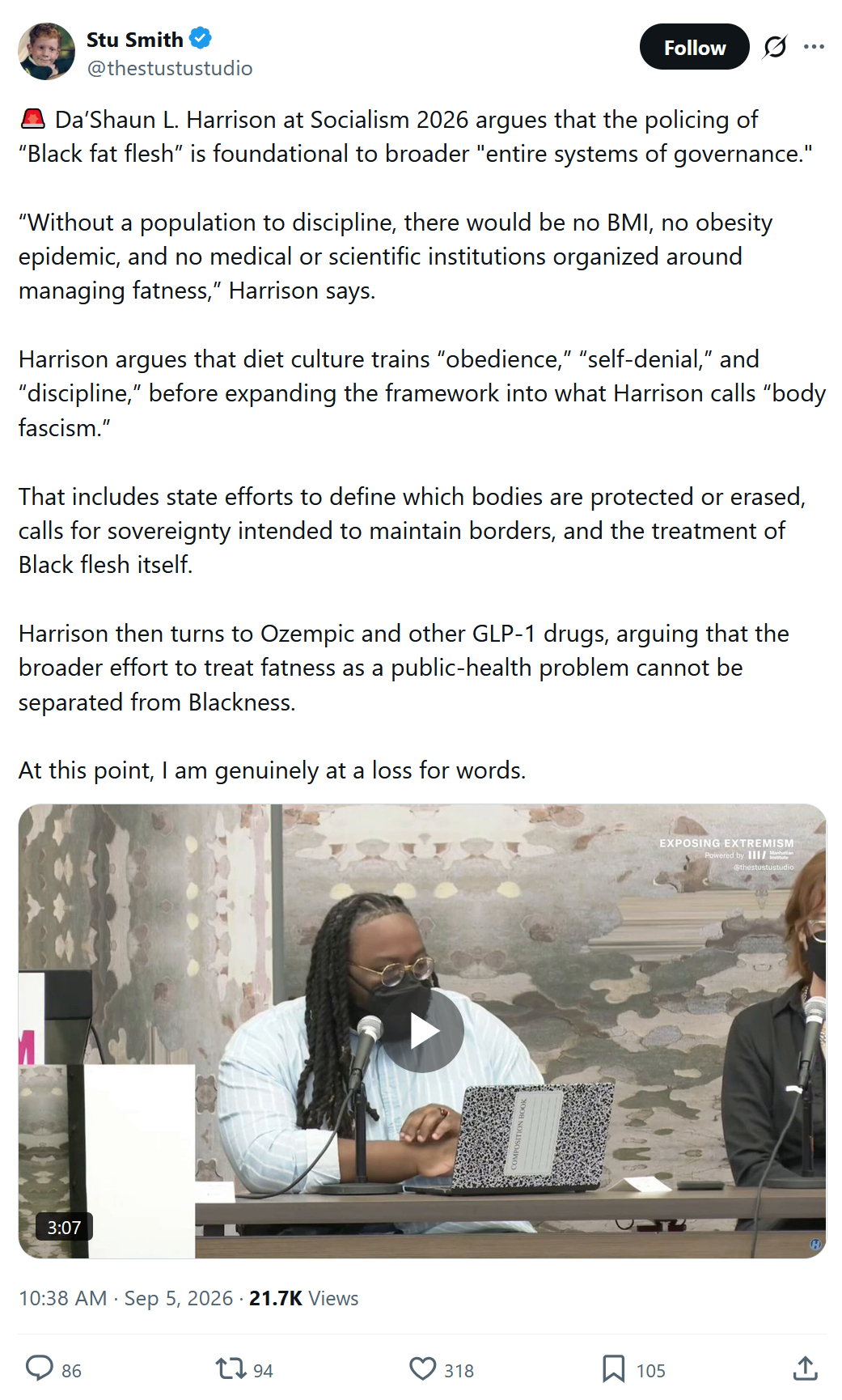
Okay, that’s a reasonable first step, but that sort of intersectionality must be extended to also include trans rights and AI rights as well:
Checking in on Bluesky and…
“trans rights are AI rights” pic.twitter.com/OcZHZ2hHrF
— Glinert 🇺🇸 🏭 (@StevenGlinert) September 4, 2026
In response to Harrison, New York City Councilwoman Vickie Paladino (R) tweets, “These deranged psychotics are in the driver seat of the Democrat party. No matter how many fables they tell about ‘affordability’ and ‘health care’ to make them seem like anything but the lunatics they are, at the end of the day this unhinged BS is what they’re actually about.”
THIS IS THE 21ST CENTURY, YOU KNOW: Tesla Cybercab First Look: No Steering Wheel! No Brake Pedal! No Problem?
BACK TO BLOOD:
A very smart political science professor told me this is one of the best replicated and most consistent findings in his field (but for some reason they don’t like to talk about it). https://t.co/keqtoEb1pd
— Coddled Affluent Professional (@feelsdesperate) September 5, 2026
QED:
Here's anti white parasite Anas Anwar giving his anti white speech in Scotland about how there's too many white people in Scotland.
If common sense had any say, he'd be deported to Pakistan with his other inbreds.
This week he was given a seat in the House of Lord's under the… pic.twitter.com/Z1PFDiPkOr
— Tommy Robinson 🇬🇧 (@TRobinsonNewEra) September 4, 2026
As Tom Wolfe wrote in his last novel, “A phrase pops into his head from out of nowhere. ‘Everybody… all of them… it’s back to blood! Religion is dying… but everybody still has to believe in something. It would be intolerable — you couldn’t stand it — to finally have to say to yourself, ‘Why keep pretending? I’m nothing but a random atom inside a supercollider known as the universe.’ But believing in by definition means blindly, irrationally, doesn’t it. So, my people, that leaves only our blood, the bloodlines that course through our very bodies, to unite us. ‘La Raza!’ as the Puerto Ricans cry out. ‘The Race!’ cries the whole world. All people, all people everywhere, have but one last thing on their minds — Back to blood!”
UPDATE (FROM GLENN): Reader John Steakley writes:
I wonder what the three-way intersection is between trust, diversity, and wealth redistribution.
I.e., if every group saw every other group pulling their own weight, then there’s not much room for resentment. But when it appears that politicians use taxes disproportionately from one group to provide benefits disproportionately to another group, that fosters resentment, and trust erodes.
To foster that resentment, one needs a diverse society AND redistributionist economic policies.
But the silver lining may be that the resentment isn’t innate; it isn’t racist; it isn’t some hardwired tribal urge; it’s man-made. It’s almost as if the politicians intentionally pander to pit one group against another for votes based on the resentment they foster with their policies.
In other words, I remain convinced that we CAN all get along, if the race-baiting politicians would let us.
Yes, in C. Vann Woodward’s The Strange Career of Jim Crow, he reports that immediately after the Civil War, race relations in the South were surprisingly good compared to what came before and after, but once the local power structure started reasserting itself it quickly had people divided in the ways it found convenient. That said, the more opportunities there are for the power structure to do that, the more likely it is to happen.
NICOLE GELINAS: Train troubles in Europe expose transit’s fatal flaw — contempt for riders.
When I traveled to Europe last month for a summer rail adventure, I knew to allow plenty of time for delays.
I learned that lesson two years ago on a similar journey, when one of my trips on the state-owned German railroad Deutsche Bahn was hours late.
What I wasn’t expecting was a DB train that didn’t run at all — with no warning and zero customer support.
The hypocritical message: We want you to take the train instead of driving or flying, but we’ll make you miserable in the process.
During my previous trip, in 2024, a four-hour ride from Cologne to Hamburg turned into a meandering seven-hour journey beset with unexplained detours.
That experience mirrored statistics: Only 60% of DB’s long-distance trains run on time.
To revise and extend the remarks by the late P.J. O’Rourke, you can’t get good Chinese takeout in China, Cuban cigars are rationed in Cuba, you can’t make movies in Hollywood, and German trains no longer run on time. That’s all you need to know about communism.
READER FAVORITE: Rechargeable Motion Sensor Closet Light, 500LM Wireless Ceiling Light White. #CommisisonEarned
WHEN SECONDS COUNT, THE POLICE ARE JUST MINUTES AWAY: Homeowner’s Gun Stops Intruder Where the Law Failed.
GET IN SHAPE: Bodylastics Patented Basic Series Resistance Band Set. #CommissionEarned
CITIZEN KANE WAS RELEASED 85 YEARS AGO TODAY:
CITIZEN KANE was released 85 years ago today.
For all the advances in filmmaking, this shot still feels untouchable. pic.twitter.com/vYrW4V5lmY
— cinesthetic. (@TheCinesthetic) September 5, 2026
Back in June at the American Thinker, wrote: Citizen Kane at 85: A Revolutionary Masterpiece Still Hiding in Plain Sight.
The picture was so different, so audacious, so avant-garde in 1941 that calling it “groundbreaking” understates the case. And because so much of filmmaking since has descended from it—or from films that themselves descended from it—it is easy now to miss the treasure hiding in plain sight. What once looked revolutionary has, by sheer force of influence, become part of the cinematic lexicon.
That is not Kane’s burden alone: it happens to every masterpiece that overturns the furniture, which the protagonist does quite literally near the end of the film.
Other filmmakers take what it did and make pieces of it their own. Then another generation borrows from them. Eventually the once-startling thing no longer looks startling at all.
It just looks like how movies are made. We still recognize the language. We do not always remember who taught us to speak it.
To appreciate just how transformative Citizen Kane was, it helps to compare it not to the films that came after it, but to the great classics that came just before.
Think of The Wizard of Oz. Think of Gone with the Wind. Think of The Philadelphia Story. These are not minor pictures, nor am I interested in diminishing them. They are classics for a reason. But place Citizen Kane beside them, and the difference becomes unmistakable.
Through that—wait for it—lens, you can see it almost immediately: in the use of light and shadow, in the use of sound and echo, in the startling deployment of deep focus, in the low and high angles and cavernous interiors, and in the determination to use the entire frame rather than treating the camera as a mere recording device.
Citizen Kane does not feel like a polished studio picture pushed to a slightly higher level. It feels like somebody came in and changed the language of cinema.
To slightly modify what I wrote back then, “Does Citizen Kane live up to the hype? Of course not—not eighty-five years later, at least. But that is precisely the point.” Actually, if there was any way to look at the film through the eyes of somebody who was going to the movies in 1941, rather than as someone who has seen innumerable movies made in the decades since which have stolen its tricks, it really does. (I watched it in June on the big screen in Arlington, TX.) Welles and his creative team, especially screenwriter Herman J. Mankiewicz, cinematographer Gregg Toland, and editor Robert Wise, created a variety of techniques to radically change how movies were told.
In the 1930s, Hollywood movies were built around the microphone, not the camera. After The Jazz Singer in 1929, movies had to be talkies, and that meant everything was subservient to recording dialogue. The actors had to speak loudly, and not overlap each other’s lines, and a rather static cutting style evolved that was built around long shots, medium shots, and closeups. Kane replaced this with deep focus photography, longer takes, a moving camera, and carefully planned overlapping dialogue, all of which can be seen in the tweet atop this post. Kane also made extensive use of the optical printer to glide seamlessly from establishing shots often created with miniatures of exteriors and matte paintings into scenes with actors.
Rather than telling its story linearly, Kane relied on a series of flashbacks, each written and performed based on the tone and mindset of the person telling the story of that segment of Charles Kane’s life, which would be ripped off by no less than Stanley Kubrick in The Killing, and Quentin Tarantino in Pulp Fiction. The optical printer was used to create the huge climbing shot in the opera house from Susan Alexander’s florid performance to the stagehand high above who hold his nose in response. That shot would be emulated by Tim Burton in his Batman movies. The vast warehouse at the end of the film containing Kane’s lifetime of possessions would later contain the Ark of the Covenant at the end of Raiders of the Lost Ark.
Citizen Kane is a film that Hollywood has endlessly ripped off. If there’s ever any chance of going into the theater and seeing it with fresh eyes, you will be astounded at the movie. But in any case, if there’s any chance of seeing it on a big screen near you, definitely go.
HEH, INDEED:
Just tell her high winds are forecast in very dry conditions and her schedule will free up to travel. https://t.co/U8li26yeDh
— Justine Bateman (@JustineBateman) September 5, 2026
Tweet of the Week: https://t.co/fVOLfqRKAd
— Christian Toto (@HollywoodInToto) September 5, 2026
WELL, THERE WOULDN’T BE MUCH POINT IN WORKING ON PROBLEMS THAT THEY DID CRACK: 33-year-old former child prodigy is working on problems Hawking and Einstein never cracked.
JUDITH MILLER: The Day That Terrorism Became a Global Spectator Sport.
Dec. 7, as most members of the so-called “greatest generation” know, is the day that Franklin Roosevelt declared would “live in infamy” when Japan bombed Pearl Harbor, belatedly drawing America into World War II. Similarly, most Americans, even those too young to have seen the Twin Towers collapse or smelled the stench of burning metal and flesh, know that Islamic terrorists changed history on Sept. 11 by killing over 3,000 people in the World Trade Center and the Pentagon. Within Israel and for Jews everywhere, Oct. 7 will long be remembered as the day that Hamas and other Palestinian enthusiasts slaughtered 1,200 Israelis and took 251 people hostage in coordinated incursions from Gaza.
What about Sept. 5? That date rings few memory bells, even for Americans who were able to watch television or follow the news in the fall of 1972. Some may dimly recall that on that day eight Palestinian terrorists from the militant Black September group infiltrated the Summer Olympics in Munich, killing two members of Israel’s national athletic team and taking nine others hostage. On Sept. 5, terrorism itself became a spectator sport.
That terrible event has now been rescued from obscurity by Tim Fehlbaum, the Swiss director and cowriter (with Moritz Binder and Alex David) whose film about ABC’s coverage of the attack more than deserves its sole Oscar nomination for best original screenplay. Fehlbaum’s September 5 is a claustrophobic newsroom thriller. The film compresses the 22-hour-long ordeal into a taut, gripping 94 minutes. It not only chronicles an early terrorist milestone, but also explores with skill and subtlety the strengths and failures of broadcast journalism, the still evolving ethics of TV news, and the beginning of a new, harsher era of mass media.
As the film tells us, Sept. 5 was the first time that an act of terrorism was broadcast live around the world. Some 900 million people watched it unfold on TV, a quarter billion more people than those who saw Neil Armstrong walk on the moon three years earlier.
From me, last year: September 5: Chilling Recreation of the First Live TV Broadcast of Terrorism.
September 5, 1972
"They're all gone."
11 members of the Israeli Olympic Team are taken hostage by a Palestinian terror group, "Black September", at the Olympic Village in Munich, West Germany.
After a failed rescue attempt, first misreported as successful, all hostages are… pic.twitter.com/FcYNMKRgjW
— Kevin Gallagher (@KevG163) September 5, 2026
RETHINKING CORE TRAINING: Why kneeling exercises deserve more attention.
JUST ABOUT THE MOST UN-AMERICA THING ANYBODY EVER SAID:
Man. We really let the universities just cook our entire country. https://t.co/DwYglrfLS9
— Spencer Pratt (@spencerpratt) September 4, 2026
WHEN PEOPLE TELL YOU WHO THEY ARE, BELIEVE THEM:
Those same people are telling you to feel sorry for a mother who strangled her children, one-by-one, for several minutes said that a 32 old mom deserved to die because she worked a midlevel corporate job at Bank of America. This is the *mainstream* of the Democrat party.
— Cernovich (@Cernovich) September 5, 2026
Earlier: The Assassination Fan Base.
NORMAN JEWISON DIDN’T INTEND FOR ROLLERBALL TO BE A HOW-TO GUIDE FOR 21st CENTURY SPORTS:
yes, a futile forray into Roller Ball. pic.twitter.com/9E1hjcUvy6
— James Ehrlichman Reinhard Koenig (@handsomocity) September 4, 2026