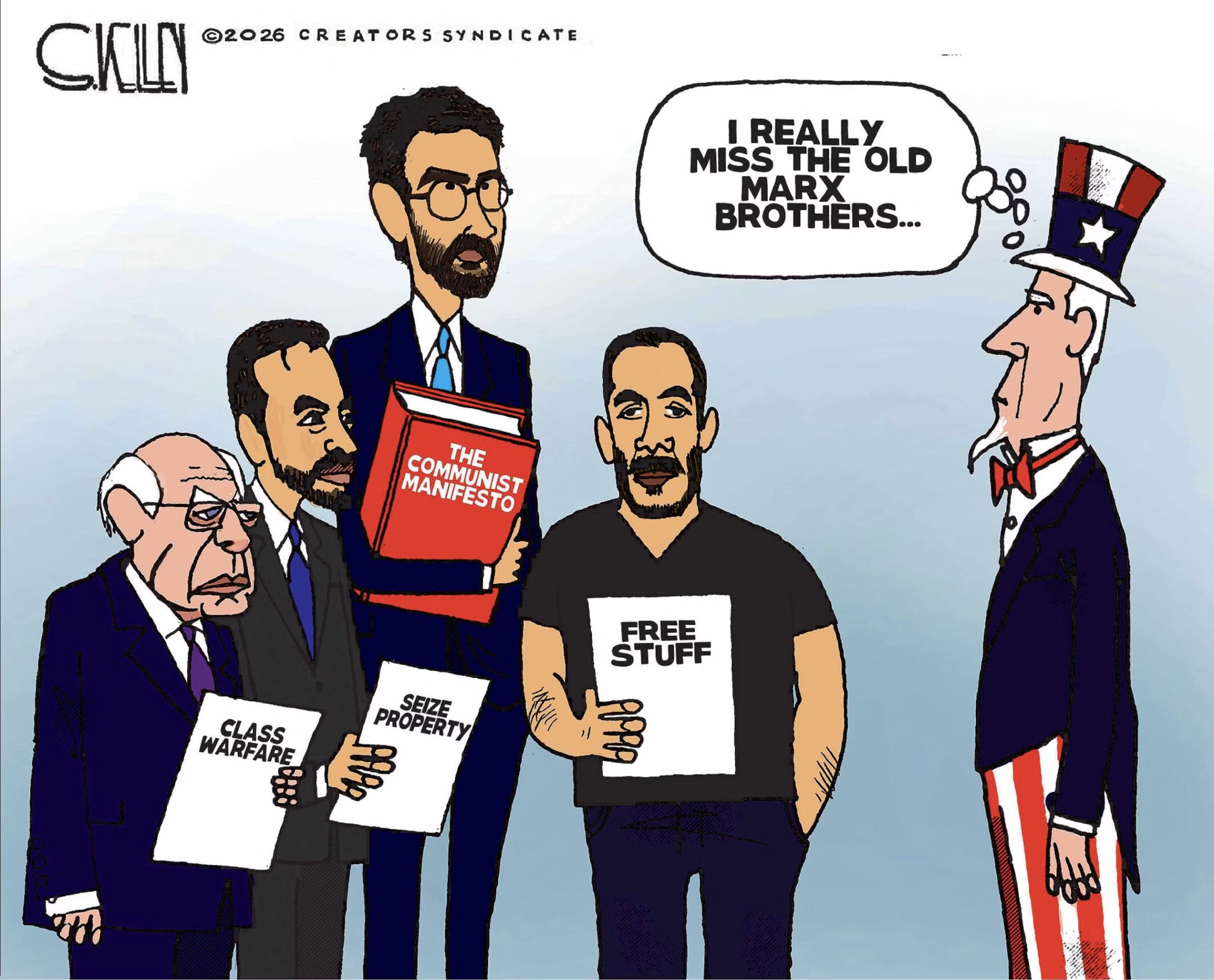
SHOCKING NEWS FROM THE WORLD OF SCIENCE: New Trial Compared Muscle Gains in Vegetarians And Meat Eaters. One Difference Stood Out.
October 10, 2026
HIGHER EDUCATION BUBBLE UPDATE: “Language and Linguistics for Decolonization and Liberation and for Peace and Community Building — From the River to the Sea in Palestine and Israel to the Mountaintops of Haiti and Beyond.”
That’s the class MIT is paying a professor not to teach.
.
PRACTICALLY HUMAN: Scientists Discover That Chimpanzees Treat Friends by Different Rules.
I BELIEVE IT’S CALLED “JUDGMENT DAY.” OpenAI And Anthropic Are Planning For ‘The Day After.’ The Fear Is A Major AI-Driven Crisis.
THE EUROPEAN MIND CANNOT COMPREHEND THE GLORIES OF TEXAS HIGH SCHOOL FOOTBALL:
Freddy has gotten VIP access to concerts, pro and college games, and World Cup games, offers for free flights on private jets, etc.
He was turned away from a Texas HS football game. https://t.co/KIxo4zrv4A
— The Poor Man (@ThePMGN) October 10, 2026
To be fair, neither can the California mind: ‘Douche’ father-of-seven sales exec who moved his family from California to Texas then BACK again is blasted for complaining about Austin’s ‘rude locals, bland culture, oppressive heat and Yelp’s bad food choices’ in scathing Op-Ed.
In parts of Texas it’s not just a monoculture, but a monoculture that doesn’t seem to be aware of its own blandness. Think about it: Are you ready to have your son judged based on his suitability for a future career in football? Are you ready to network by attending the local high school football game with the guys? Because that’s a thing in Texas.
Really? Who knew that Texans were obsessed with football, especially high school football? It’s not like Hollywood ever made a movie on that topic that was eventually transformed into a weekly TV series.
QUANTUM BIBLE: Quantum Physics demonstrates the reality that one entity can simultaneously have two or more identities. And Dr. Michael Quillen, former ABC Science Editor and Professor at Harvard and Cornell, demonstrates that Christianity makes sense in a quantum context.
FINALLY: World Without Cows.
“World Without Cows” isn’t officially an 81-minute cattle-industry advertisement arguing that beef is crucial to humankind’s survival, but skeptical viewers can be forgiven for thinking it is. The big takeaway from this documentary is: yes, as you’ve heard, cows (a catch-all here that incorporates all kinds of “beef animals,” to use the movie’s language) do require a tremendous amount of food themselves, and their care takes up a lot of real estate all over the world, but without them, much of the world would be even hungrier than it is at the moment, and…
We’ll unpack all this in due course. For now, let’s say that, for all its intelligence and sensitivity, watching this movie feels a bit like listening to an automobile dealer explain why we can’t live without cars. The author of this review, while not pro- or anti-cow, is far from a vegan, and in fact took the family to Charco Broiler before watching this movie, and is not likely to lead protests against the cattle industry or the businesses that support them anytime soon, but also wouldn’t stop anybody who wanted to. But many aspects of “World Without Cows” may set off your own b.s. detector, and not just because the movie’s pro-beef arguments focus largely on cows’ consumption and excretion of vegetable matter.
I’m holding out for the sequel, “World Without Farting Airplanes.”
OUT ON A LIMB: Why US critics are wrong to claim Britain should have stayed out of the Second World War.
The legacy of war is increasingly disputed in Britain too, however absurd that might sound, despite expressions of pride in our “finest hour” and cheerful evocation of “the Dunkirk spirit”. For decades, some historians have been busily chipping away at what they consider an indulgent myth. From the Left, attempts have been made to debunk national unity, foregrounding issues such as desertion, black marketeering, government incompetence and snobbery towards working-class evacuees.
From the radical Right came efforts to belittle Britain’s victory as the cause of post-war complacency, economic decline, welfarism and delusions of grandeur. At least one Right-wing historian criticised Churchill for refusing a deal with Adolf Hitler to preserve Britain’s empire, wealth and great-power status. More recently, Remainer historians blamed “nostalgia” for the war for Brexit. Promoters of “decolonisation” want to demolish any sense of Britain as pursuing a brave and necessary struggle. They condemn Churchill as an imperialist villain, and one voluble activist has accused the British Empire of being worse than the Nazis.
Now, celebrities on the American Right have taken up some of these themes in the name of isolationism and amoral realpolitik. Tucker Carlson, an American political commentator who spoke to Jacob Rees-Mogg on his show earlier this month, argued that Britain was foolish to throw itself into a global war when it could have done a deal – as if war is a business transaction to be assessed in terms of profit and loss.
Tucker really can’t be called a “celebrity on the American Right” anymore. Ever since the Nixon era, a man with Very Serious Hair could make a very good living in the Northeast Corridor as a talking head who poses as a Republican, but somehow, can never find an actual Republican to endorse. Since the fall of 2024, Tucker has taken that role about as far as it can go.
BESSENT YOU MAGNIFICENT BASTARD:
.@SecScottBessent to @SenWarren: “Happy Indigenous Peoples’ Day to you and your family.” https://t.co/gcJEwOLlQY
— Rapid Response 47 (@RapidResponse47) October 10, 2026
DETECT AFIB: KardiaMobile 1-Lead EKG Monitor. #CommissionEarned
I REMEMBER WHEN BILLIONAIRE MONEY IN POLITICS WAS SUPPOSED TO BE BAD: Everytown Pumps Another $10 Million of Michael Bloomberg’s Cash Into the 2026 Midterms.
GET SOME EXERCISE: Cubii JR1, Under Desk Elliptical. #CommissionEarned
A KISS IS STILL A KISS: Why did kissing evolve? If we want to find out, we’ve got to decide what counts as a kiss first.
THE MEMES ARE HERE. LET THE WEEKEND BEGIN: Memes to Start the Weekend.
STILL A FEW BUGS IN THE SYSTEM: A teen used AI to plan a hiking route. It trapped him on a cliff.
BECOMING UNCANCELLED:
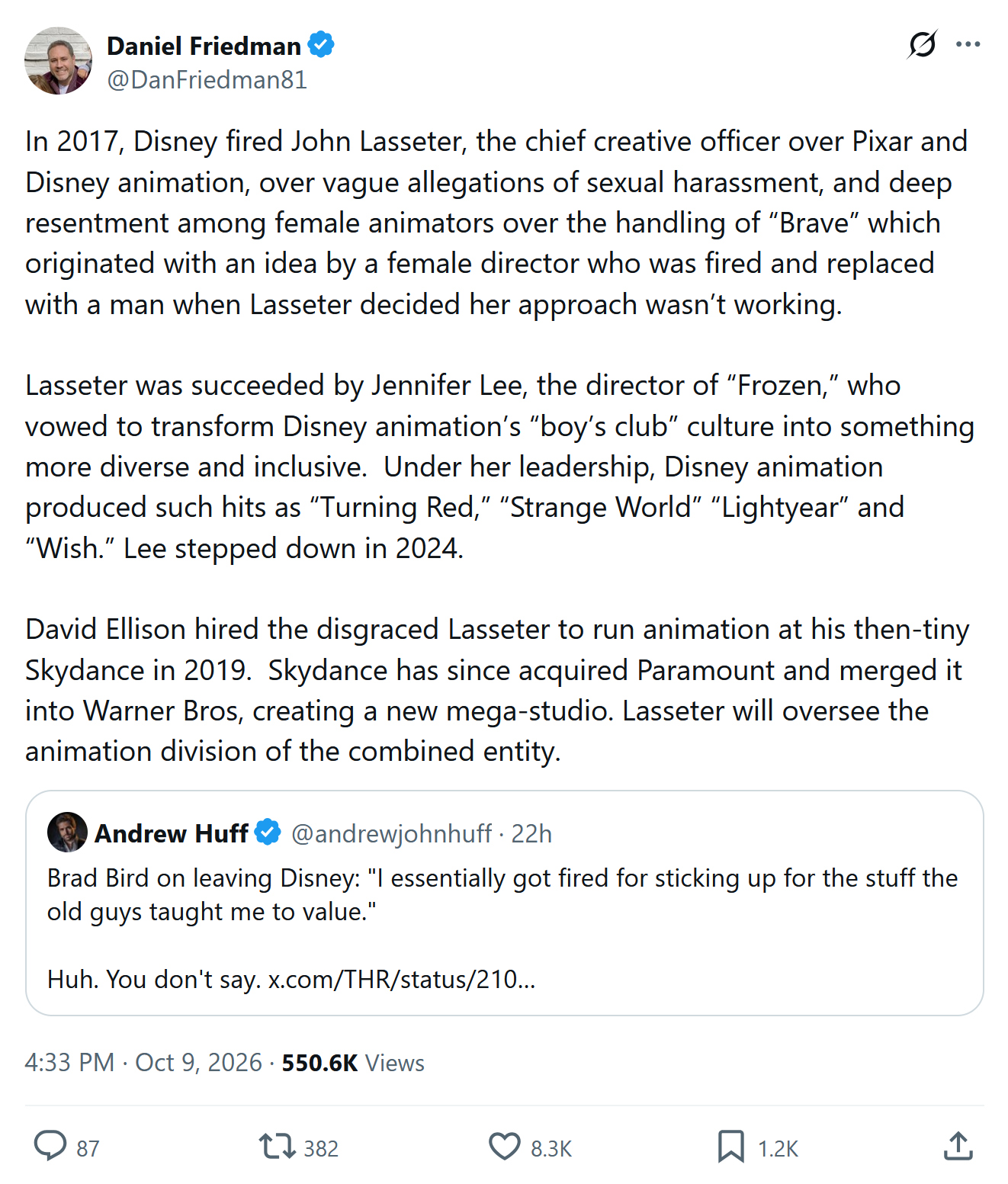
Mad Men was never a commercial hit, but by God, it was loved by critics, leading Michael Idov to write at Vulture in 2015, “How the Media Forced Mad Men Down the World’s Throat.” But even then, the world wasn’t swallowing the bait:
Next March, AMC’s Mad Men will return to the airwaves after a year and a half absence. It’s return will be treated as the most significant cultural event of the year. Its stars will blanket the covers of our glossy magazines. Articles will be written in the New York Times and our most elite literary journals dissecting the show’s meaning. Banana Republic will promote its high end Mad Men line.
Mad Men at its height was watched by 2.9 million viewers. In contrast, CBS’ military police procedural drama NCIS last week was seen by 19.7 million viewers. As far as I can tell, NCIS has never been featured on the cover of any major American magazine apart from TV Guide and one issue of Inland Empire, the magazine of California’s suburban Riverside and San Bernadino counties.
Matthew Weiner, the show’s creator got massive amounts of hagiographic ink in the 2010s, until he was similarly #metooed into oblivion in 2017. He’s now producing a new show for Eddie Murphy: Eddie Murphy to Star in Peacock Drama Series The Chairman From Mad Men Creator Matthew Weiner.
Murphy is among the world’s all-time greatest comedians, having launched his career as a cast member on “Saturday Night Live” for four seasons from 1980 to 1984. Since then, he has focused on comedy specials and movies; his only scripted TV role before “The Chairman” was voice acting on “The PJs,” an animated series he co-created. On the big screen, his credits include the “Beverly Hills Cop” franchise (1984-2024), “Coming to America” (1988), “Harlem Nights” (1989), “Dr. Dolittle” (1998), “Dreamgirls” (2006), “Dolemite Is My Name” (2019) and more.
Weiner is best known for creating and serving as showrunner on “Mad Men,” which ran for seven seasons on AMC from 2007 to 2015 and is widely regarded as one of the best TV series of all time. He was also a writer and executive producer on “The Sopranos.” Other credits include writing and producing on CBS’ “Becker” (1999-2002) and the 2018 Amazon Prime Video anthology series “The Romanoffs,” which he created.
That’s where Variety’s article ends, which is where Weiner’s career in TV ended until now. Who is next in Hollywood to get a shot at redemption after the purges of the late 2010s?
COLUMBUS DAY TRUTH: No, contrary to the Left’s DEI-based Fables of Western Civilization, Rod Martin explains, Europeans led by Columbus, did not commit genocide against the Native population.
NEWS YOU CAN USE: Salmon vs. Fish Oil Supplements: Which Is Better for Brain Health?
ELON MUSK’S ENEMIES MAKE HIS BEST CASE:
In 2023, Alex Gibney, the Academy Award-winning filmmaker, announced that he was working on a documentary about Elon Musk. He asked Musk for an interview. The answer was delivered on X: “Gibney,” Musk informed his 241.5 million followers, “is a douche.”
You could take the world’s richest man at his word. Or you could spend three hours and 55 minutes watching Gibney do his best to prove Musk right.
* * * * * * * *
The real America, the one we know from discernible and observable facts, is nowhere on display. In Gibneystan, no record exists of Musk the champion environmentalist, hailed by the left until he refused to continue and parrot its platitudes. Nor is there any mention of Big Tech’s frequent and egregious collusion with Democrat-controlled administrations; the sin of seeking proximity to political power is unique to the devilish Musk himself.
And Gibneystan might’ve been an amusing place to visit for a few hours if it weren’t for the fact that its denizens wish to impose their strange worldview on the rest of us. As each of Gibney’s interviewees makes clear, theirs is an America in which we oughtn’t to be proud, oughtn’t to work hard, oughtn’t to attempt audacious things. Walking out of Musk, one suspects that had Gibney turned his attention to the moon landing instead, he would’ve given us a portrait of Neil Armstrong as a privileged cisgender white male tragically colonizing the moon.*
None of this, however, is to say that Musk isn’t an effective or an entertaining film. See it, and it’s very likely that even if you entered the theater skeptical about its subject’s achievements, you’ll leave it with a strong, inexplicable desire to dash down to your local Tesla dealer or Starlink retailer and spend some cash to support Elon Musk.
That’s because whatever else he may be, Alex Gibney is a proficient filmmaker, and the choice he gives us in his latest epic is simple: We can live in a world governed by mutually accrediting mediocrities who obfuscate to enforce their strange and zealous ideological beliefs on the rest of us, or we can live in a world where ambitious, curious, and patriotic Americans dream big and go for broke. For most of us, the choice is easy.
* Don’t worry, Hollywood has already made that movie: First Man: One Giant Flop for Moviekind.
LIMITED TIME DEAL: Inspire Black Nitrile Disposable Gloves. #CommissionEarned
DAVID THOMPSON: The Urge To Call You Names.
It turns out that if you’re unhappy about the demographic displacement currently underway – say, in your own, modest neighbourhood, Cate Blanchett questions your humanity and thinks you need educating by actors.
Ms Blanchett, needless to say, is unlikely ever to face any of the issues illustrated above. Living, as she does, in a five-million-pound Victorian manor on a thirteen-acre estate near the overwhelmingly white town of Crowborough in East Sussex. And her other properties, including what is referred to as a holiday cottage in Cornwall, are similarly insulated from any untoward diversity.
As Ms Blanchett doesn’t have to use public transport for a daily commute, she isn’t likely to find herself sitting next to a masturbating African. And she isn’t likely to find all that vibrancy and enrichment crouching on her doorstep and taking a shit.
And Ms Blanchett isn’t likely to find exotic newcomers, these supposed bringers of our betterment, creeping into her garden at night and peering through her windows to watch her, and film her, for erotic purposes.
Well, of course Blanchett chose the path of least resistance for thesp in 21st-century England. Consider the alternative: The Monty Python legend, who has spent decades mocking religious dogma, was reported to Britain’s Prevent program for criticizing Islam. Andrew Doyle explains in The Washington Post why confusing offensive speech with a terrorist threat is a dangerous road to go down.
Similarly, in America, another aging actress reads the script to remain employable in Hollywood: Actress Ellen Barkin Says ‘Burn ICE to the Ground’ After Shooting of Violent Illegal Alien.
TYLER O’NEIL: Rubio’s Rousing Athens Speech Highlights the Infrastructure Demonizing the West.
Rubio contrasted the ancient Greek “thumos”—the “fire of passion, strength, courage, pride” that helps civilizations succeed—with the current malaise often associated with the “woke” movement.
“Over time, we in the West came to feel ashamed of the very things that made us exceptional,” he warned, noting the tearing down of monuments. “We felt embarrassed that our achievements set us apart from the rest of the world. Our prosperity somehow became a source of guilt. We no longer believed we deserved and had earned our greatness.”
Rubio warned that modern ideologies seem to aim at “a world of perfect safety, devoid of risk or failure, with neither the glory of victory nor the shame of defeat.” He lamented that such an approach leads the West to “design our standards to ensure that no one will lose,” and ultimately “hold the most exceptional things among us hostage to the average, the ordinary, the mediocre.”
It was an excellent condemnation of the ideology behind “diversity, equity, and inclusion.” Rubio wasn’t just rejecting the mentality that says we must count every university applicant or every member of a corporate boardroom by race, sex, and sexual orientation; he was condemning the underlying assumption that America is inherently biased against certain groups and that we must atone for this national sin by elevating them.
This critical race theory isn’t cloistered away in some isolated ivory tower. It recently held sway in the commanding heights of American culture, and its institutional framework persists even today.
Earlier, from Glenn at his Substack: Marco Goes Hard — About what really matters.