October 17, 2026
MICROBIOME NEWS: Giant bacteria could be living in your gut. “Our gut microbiome is home to trillions of microbes, but they may not all be microscopic. Giant bacteria, which can reach a centimetre in length, are generally found in niche environments, such as mangroves and fish guts. But now, microbiologists have detected signs of DNA from Epulopiscium, one of the largest known types of bacteria, in human gut microbiomes from around the world. Bacteria are usually around 2 micrometres long, while giant ones are generally defined as being larger than 10 micrometres. But species belonging to the Epulopiscium genus can reach up to 600 micrometres – more than half a millimetre – in length.”
IS PARIS SCUFFLING?
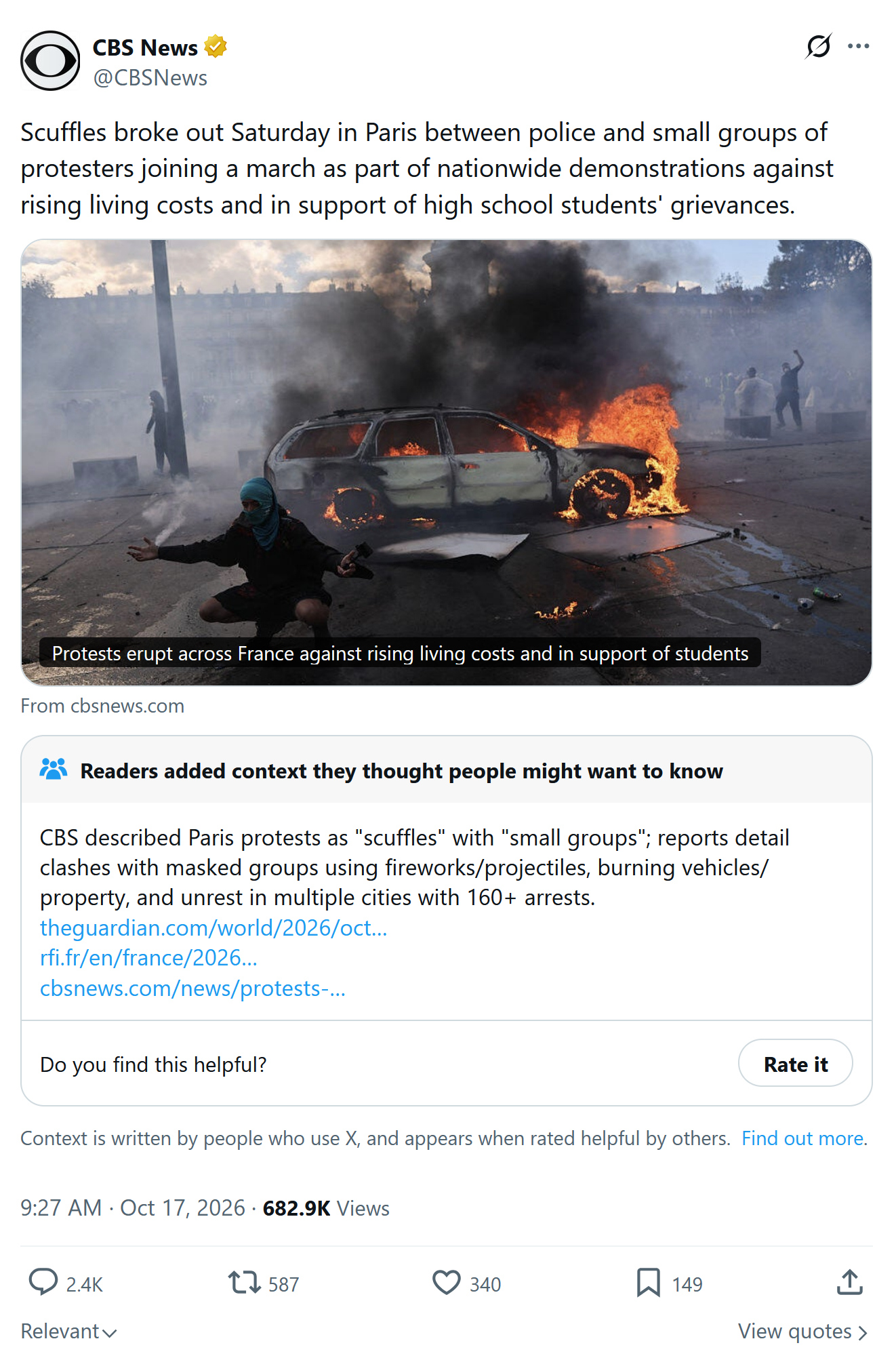
Or to paraphrase CNN in 2020, mostly peaceful but surprisingly fiery scuffles.
Bari Weiss needs to get CBS’s social media team under her control:
@bariweiss still not in control of this beast. https://t.co/bGTEnlecYE
— David Mastio (@DavidMastio) October 17, 2026
UPDATE: Sasha Stone: Riots in France — a Warning for America.
MORE: Hot Takes: Internet Rips CBS News for the Worst Tweet on French Riots Since ‘Mostly Peaceful.’
REMEMBER THIS?
Like it never happened.
Insane. https://t.co/rpKDxWWhwo
— C3 (@C_3C_3) October 17, 2026
GREAT WORKOUT SOCKS: Swiftwick ASPIRE Zero No Show Performance Running Socks. #CommisisonEarned
THERE SHOULD BE THE DEATH PENALTY FOR THIS KIND OF THING: Before COVID, an NIH lab chief proposed making a SARS-like bat virus more infectious: Newly released records show Vincent Munster suggested inserting a furin cleavage site and that his lab obtained unpublished SARS-related sequences. Nothing links the research to SARS-CoV-2.
It’s actually worse if multiple people were wanting to do this.
WELL, YES:
🚨 OMG. Stunning resurfaced footage shows Ugandan Mayor Mamdani saying the plan is to manipulate white leftists into electing 3rd worlders like him
Spoken in his 3rd world accent: "You need someone to be a validator, tell them to TRUST US."
🤯🤯
"Minority communities, because… pic.twitter.com/dtIsGUOmSz
— Pulse Leaks 1.0 (@Pulse_Leaks) October 16, 2026
We’ve seen something similar play out in Europe, and we know what comes next:
If this isn’t civil war, what is it? https://t.co/hpfVOeaZJj
— Rod Dreher (@roddreher) October 17, 2026
It’s an invasion, Rod — those people were never French.
RELIGION OF PEACE UPDATE:
What they simulated on this statue's eyes is also what the Bataclan terrorists did to countless victims 10 years ago.
Believe them when they tell you who they are. pic.twitter.com/UzPl8zq6oX
— 𝐍𝐢𝐨𝐡 𝐁𝐞𝐫𝐠 🇮🇷 ✡︎ (@NiohBerg) October 17, 2026
HONESTLY, IT’S BEEN A LONG TIME…:
Un. Fucking. Believable.
I went to war for GWB. I regret every moment supporting him. Ever. https://t.co/kAC2rlVvO2
— Buzz Patterson (@BuzzPatterson) October 17, 2026
…since this kind of thing from a Bush family member was unbelievable.
LIMITED TIME DEAL: Hair Cutting Scissors. #CommissionEarned
MEMES TO LAUGH THIS WEEKEND: It’s October and the Memes are Golden.
THAT’S (D)IFFERENT BECAUSE SHUT UP:
Rashida Tlaib after Mar-a-Lago was raided:
"No one is above the law, no matter how rich or powerful they are. Let justice be served."
Rashida Tlaib after Ilhan Omar's house was raided:
"DHS raiding a Member of Congress's home is exactly what a fascist police state does."
— Nick Adams (@NickAdamsinUSA) October 16, 2026
Double standards are the best because you get twice as many.
LIMITED TIME DEAL: Windproof Travel Umbrella – Compact & Withstands Winds up to 100MPH. #CommissionEarned
AMERICA’S NEWSPAPER OF RECORD:
Trump Criticized For Choosing New Press Secretary Jessica Rabbit https://t.co/J3fbLYQj0v
— The Babylon Bee (@TheBabylonBee) October 16, 2026
THEY’RE ALWAYS IN THE LAST PLACE YOU LOOK: 1,000-Foot ‘Invisible’ Waves Are Tearing Through the Deep Ocean.
FREEDOM LESSONS IN THE TESLA ROCKET CAR: Yes, Elon Musk’s Tesla Roadster Rocket (TRR) was only airborne in controlled flight a few seconds, but that’s just the barest of hints of what could be coming in the transportation field in the near future, thanks to the freedom that enables innovators to take risks, develop new ideas, test them, then be rewarded when market success arrives.
Check out my new Substack column today on Mark Tapscott’s Copy Desk concerning the long list of technological innovations encouraged and enabled through individual freedom and free enterprise.
REAL-WORLD HERO:
A 16-year-old girl was kidnapped at gunpoint while waiting for her school bus. Just 30 minutes later, she stood beside her alleged kidnapper inside a gas station and silently mouthed one word to the clerk: “Help.”
It happened in Michigan, where a stranger had forced the teenager… pic.twitter.com/A0EUmphcad
— Hosna ⚖️ בניטה (@DOGEQEEN) October 16, 2026
More:
It happened in Michigan, where a stranger had forced the teenager into a van at gunpoint. When the man brought her into a Sunoco gas station and demanded that she buy him cigarettes, clerk Abdulrahman Abohatem immediately sensed something was wrong. The girl was visibly frightened, and her desperate attempt to signal him confirmed his worst fears.
Abdulrahman had no idea what the man might do next. But instead of staying safely behind the protective glass at his counter, he stepped out and confronted him. He physically placed himself between the stranger and the girl, told her to get behind him, and ordered the man out of the store.
It was an extraordinary act of courage. Abdulrahman was an ordinary gas station employee putting himself in harm’s way to protect a teenager he had never met.
More at the link.
OH, THAT ECO- APOCALYPTICISM: They War-Gamed Dimming the Sun. It Went Even Worse Than You Think.
The simulation, titled Exploring Geopolitical Tipping Points and Climate Cooling Strategies, saw a couple dozen foreign-relations experts, scientists, military personnel, and former government officials from across the world convene in a meeting room at Queen Mary University of London. After making introductions over coffee and little yogurts, they sat at tables arranged in a square with the name of the country or organization each person was playing: national governments, climate NGOs and nonprofits, indigenous groups, and tech companies. Golja was assigned to provide technical advice to help participants make scientifically literate decisions.
The point of the game was to stress-test the world’s response to a group of prospective technologies known collectively as solar radiation modification. These technologies promise to reverse global warming by reflecting away a portion of the sunlight reaching Earth, for example by spraying particles of sulphur dioxide or some other manufactured substance into the atmosphere. The cooling effect of this kind of solar geoengineering is widely accepted. It would mimic the well-known impacts of large volcanic eruptions, which temporarily cool the planet by half a degree or more. But the fallout is less certain—and less equal. Some regions will suffer: Models predict drying in sub-Saharan Africa and more intense tropical storms in the Atlantic. The cooling effect would also last only as long as the geoengineering continued; after that the global temperature could shoot back up with wild and hard-to-predict effects.
Until recently*, the idea of solar radiation modification was a speculative niche of climate science. That has changed fast. Private firms are exploring solar geoengineering as a commercial opportunity: Last year, a US-Israeli startup called Stardust Solutions raised $60 million, and in May it released details of a suite of new inventions it claims would give humans the ability to dial down the global temperature as desired. In August, Elon Musk, whose company SpaceX might be a candidate for delivering geoengineering interventions, threw his voice behind solar geoengineering, writing on X: “Space satellites to control temperature and massive geo-engineering will be needed or it will be game over.”
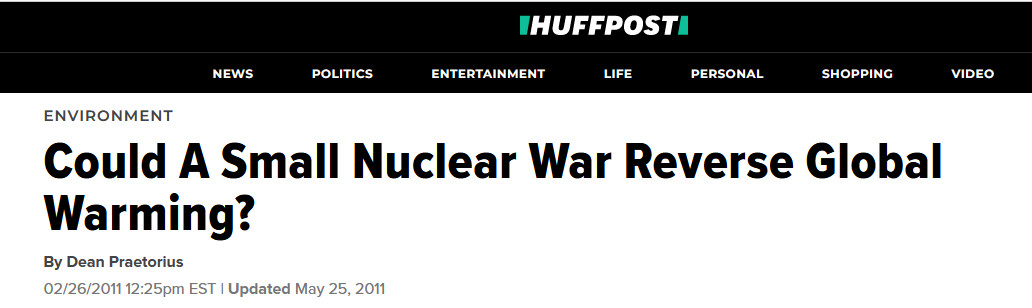
* Define “recently,” please. Presumably Obama rejected such craziness when his “science” “czar” was discussing it in po-faced tones with AP in 2009, at the peak of Barry’s Hopenchange era:
But why futz around with half measures?
GIVE THE PEOPLE WHAT THEY WANT: A dog longevity pill is nearing FDA approval. A vet explains what it can and can’t do.
QUESTION ASKED: Why were Victorian elites so effective?
Books about successful people often make success sound rather unappealing. Education should be intense and rigorous, focused on driving up IQ and on the ‘STEM’ quaternity of science, technology, engineering, and mathematics. Once adulthood is reached, life follows an austere pattern, with a 5am start, cold baths, daily visits to the gym, little or no alcohol, a Huel-rich diet, and Stakhanovite working hours. This last point generates particular excitement, and descriptions of powerful people dwell with eager fascination on how many hours they devote to their labors.
The elites of Victorian Britain operated differently. Their schools and universities were not terribly academic and had very little STEM. As adults, they got up late, drank a lot, and spent a remarkable share of their waking hours partying. They loved feasting, sports, holidays, dancing, and dressing up. Contrary to their stodgy reputation, they were probably a lot of fun.
Despite this, the elites of nineteenth-century Britain were, by their own lights, extremely successful. For much of the century, Britain was the richest country on Earth. Its companies dominated global commerce, industry and finance. Its huge navy reigned over the world’s oceans, and its tiny army won a long sequence of wars while keeping watch over an enormous empire. Britain progressed gradually toward democracy with none of the revolutions and civil wars that wracked continental Europe. There is a longstanding view that the prosperity of Britain’s elites came at the cost of the hundreds of millions whom they subordinated and oppressed, and no doubt that is at least partly true. But on their own terms, the British ruling class enjoyed a victorious century.
Maybe the Victorian elite succeeded in spite of being feckless and incompetent: the Industrial Revolution created great wealth, which they enjoyed passively and parasitically. We cannot run controlled experiments on Victorian Britain, so this thesis is hard to test. But I want to explore the possibility that a relentless focus on soft skills, team building, and intra-elite networking actually worked rather well. Huel, STEM, and cold baths have their merits. But the example of the Victorians should make us hesitate before concluding that there is only one way to rule the world.
Read the whole thing.
THE FUTURE…:
2 nights ago I saw a car fly.
This morning I saw a taxi without a driver.
A few weeks ago I saw a rocket caught out of mid air.
In Vegas I got to the convention center going through a tunnel.
During the floods in Texas, I used Starlink to connect to First Responders.…
— Gunther Eagleman™ (@GuntherEagleman) October 17, 2026
…and its enemies:
"I don't want flying cars. I want raw nature and real human connection."
Brother…
YOU are CURRENTLY SELLING $50 worth of protein bars that were not foraged, not hunted, and not hand-pressed by a village elder at dawn but manufactured in a FACILITY on a production line powered… https://t.co/AGARQeCue0
— Matt Van Swol (@mattvanswol) October 17, 2026
How many years — decades? — closer has Musk brought the future?
So far.
LIGHTNING DEAL: BLACKDOG Military Dog Shock Collar. #CommissionEarned