September 30, 2026
I’m not impressed with that. Humans anthromorphize everything. Cars, boats; research even shows kids see Alexa and Roombas as moral beings. Even Tim The Pencil.
CIVIL RIGHTS UPDATE: Anti-Gun Orgs Bullied YouTube Into Squeezing Gun Content Creators Even Harder. “Gun control advocates appear to have succeeded in pushing YouTube to change its policies to restrict firearm-related content and tighten its rules governing manufacturer-supported videos. Is it just a coincidence? The implications extend beyond whether “GunTubers” can publish a product review. They reach the increasingly consequential question of when independent firearm coverage becomes corporate advertising.”
DANIEL GREENFIELD: Bari Weiss is Destroying CBS News.
It would be awful indeed if Bari Weiss were to tamper with the journalistic legacy of CBS greats like Walter Cronkite, Les Moonves (accused of forcing a woman into oral sex), former 60 Minutes Executive Producer Jeff Fager (accused of sexually harassing women), former 60 Minutes correspondent Charlie Rose (accused of sexually harassing women), former 60 Minutes Executive Producer Don Hewitt (accused of sexually harassing women) making “accused of sexually harassing women” into an official requirement for CBS News legends.
At least there was Dan Rather, who broke the network’s curse of sexually harassing women by merely trying to pass off a Microsoft Word document as if it had come from the Vietnam War.
Obviously, Bari Weiss doesn’t belong at CBS News. She hasn’t even raped anyone yet.
Read the whole thing.
When Dick Ebersol returned to produce Saturday Night Live after Jean Dumainian’s disastrous stint replacing Lorne Michaels in 1980, one of his first hires was original head writer Michael O’Donoghue, who returned because he wanted to give the show a “‘decent Viking funeral.’ He thought it would be fun to see the show go out in a blaze of glory, to make one last courageous charge into the banal maw of network TV,” according to Doug Hill and Jeff Weingrad in their 1986 book, Saturday Night: A Backstage History of Saturday Night Live. With the legacy media fading into senescence in general, perhaps Weiss can actually accomplish a well-deserved Götterdämmerung at the formerly self-described “Tiffany Network.”
MASKS OFF:
They had them at “Death to America.”
I expect this new variant will resonate with the target audience. https://t.co/Cpyrw1JpBM
— Northern Barbarian (@xnoesbueno) September 30, 2026
“ALTERCATION” IS JUST ANOTHER WORD FOR THE TERRORIST HIJACKINGS WE THWART TOGETHER:
Delete your paper.
— Stephen Green (@VodkaPundit) September 30, 2026
The Community Notes are appropriately brutal, if you’d like to vote them to Helpful status.
SHADES OF 9/11: FlyDubai Pilot Attempts Hijacking, Mass Destruction.
Imagine if Flight 93 had had a happy ending. Israel and Saudi Arabia may have just experienced their own version, 25 years later.
The Wall Street Journal reports cautiously on what appears to be a terrorist hijacking over Israel. Their report notes a “struggle” in the cockpit, a steep dive, and an intervention by passengers to resolve it:
Pilots on a FlyDubai flight to Israel were injured after a struggle in the cockpit that sent the plane into a steep dive before it made an emergency landing in Saudi Arabia.
FlyDubai, the sister airline to the long-haul carrier Emirates, didn’t explain what happened in the flight for the Boeing 737 MAX 8 aircraft, only saying that it “experienced an incident while en route.” Flight FZ1073 landed in Tabuk in western Saudi Arabia and “all passengers are safe and accounted for,” the carrier added.
A statement from the Tabuk airport said “the captain and the co-pilot sustained injuries and were transported to the hospital for necessary medical care.” It did not elaborate on the cause of the injuries.
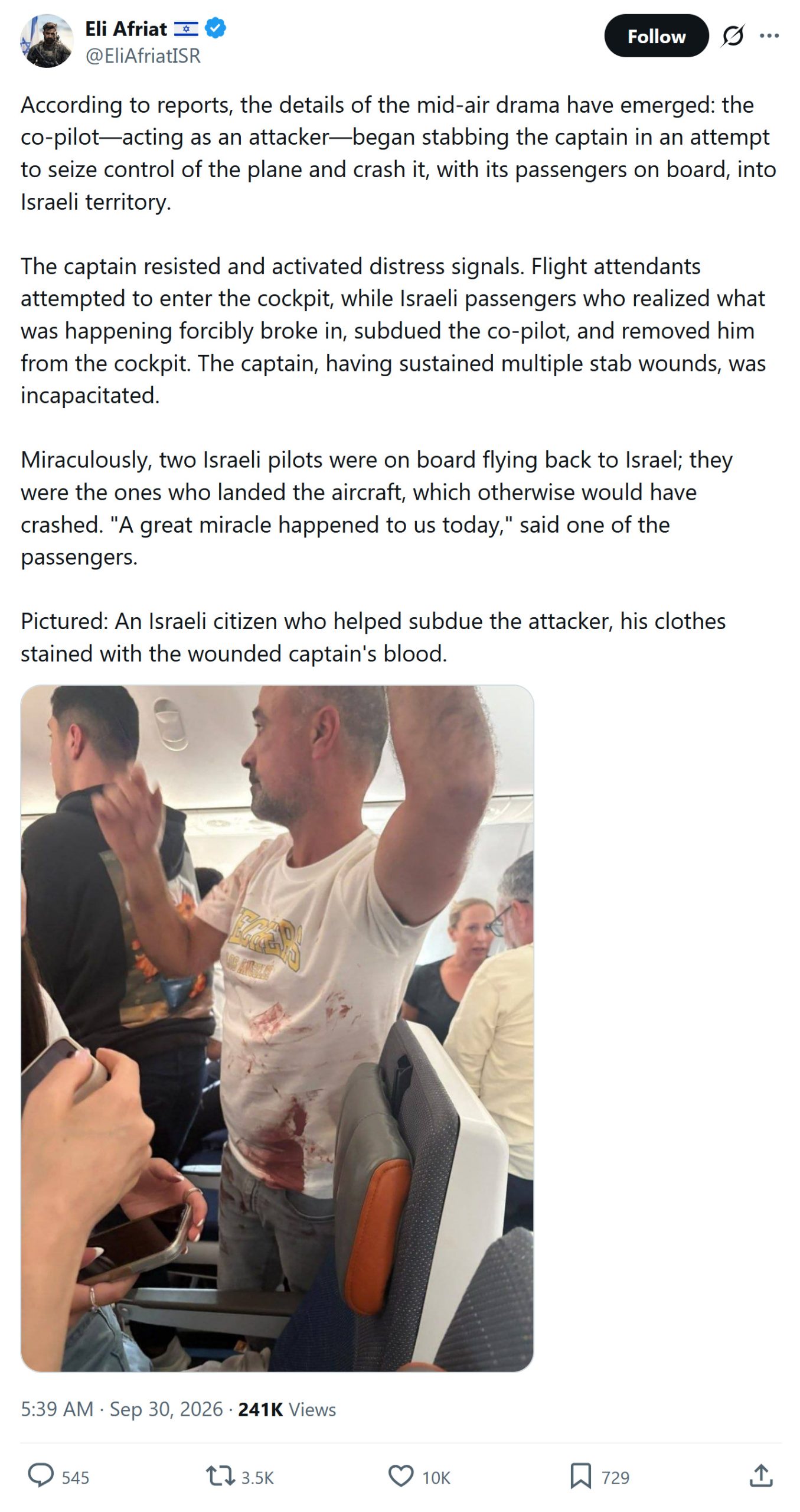
Itzhak Liber, a person who identified himself on his Facebook page as being a passenger on the flight, said in a video from the plane that an attacker stabbed a pilot. Liber said some on board had stepped in and removed the attacker from the cockpit.
The Times of Israel has a much more robust account of the attempted hijacking. The terrorist turns out to be the FlyDubai co-pilot, hired less than a year earlier, on a flight from Dubai to Tel Aviv. After stabbing the captain, the co-pilot dove the plane 17,000 feet until passengers breached the cockpit and saved their own lives, not to mention whatever the co-pilot may have aimed the plane at in Saudi Arabia or Israel[.]
More here: Flydubai Co-Pilot Stabs Captain Midair — Israeli Passengers Subdue Him Before the Plane Can Crash.
Not surprisingly, this gentleman is rather elated to have survived:
The old gods walk amongst us yet, and would toy with us.
Sometimes they send a hero. Not always.
Grandaddy of Gods, that wrathful OT one, He stepped in today. He sent Israelis.
He also sent this guy. https://t.co/xaSj1a9T0G
— Northern Barbarian (@xnoesbueno) September 30, 2026
UPDATE: Pilot ‘stabbed’ in suspected hijacking of Israel-bound passenger flight.
Benjamin Netanyahu, the Israeli prime minister, said one of the pilots “stabbed the other pilot and apparently tried to crash the plane” on the Flydubai plane.
He described how a passenger and a member of the crew managed to “neutralise” the co-pilot while another crew member took control of the plane.
The suspected assailant is in custody and currently being questioned by the Saudi authorities, he added.
Itamar Ben-Gvir, Israel’s national security minister, said the incident showed Israel must continue its war efforts.
He said: “Thank God and the heroic passengers, but Israel’s security doctrine must be taken to the next level. We must not stop and must continue until achieving total victory in Iran, Lebanon, Gaza and Judea and Samaria.”
Exit quote: “Mr Ben-Gvir, also a member of the security cabinet, said: ‘The naive notion that our enemies value life and that we should have mercy on them was met with another reminder this morning in the form of a terrorist who planned to crash a plane and murder the 180 Israelis on board.’”
Meanwhile as far as the Gray Lady is concerned, its origin and purpose, still a total mystery:
Who you gonna believe? Me or your lying eyes? https://t.co/k00dYmqy3c
— varifrank (@varifrank) September 30, 2026
MORE:
ROBERT G. NATELSON: The Slippery Constitutionality of Open Primaries.
Open and semi-closed primary laws have been around for some time. However, in recent years they have proliferated, promoted mostly by center-left organizations.
The most salient stated goal for promoting these laws is to favor “moderate” candidates who “appeal to a wider portion of the electorate” over more “extreme” and “partisan” candidates. The promoting organizations contend that parties must accept such restrictions in exchange for state financing of primary elections. Constitutional wonks may recognize that the latter argument disregards the Supreme Court’s unconstitutional conditions doctrine: A state may not force you to give up a constitutional right in order to receive a government benefit.
I suspect that the sponsors’ primary goal is to affect GOP primaries. Outside a few regions where socialists can win intra-Democratic Party races, most Democrat primaries display few real policy differences. It is in Republican contests where the real debate happens. The goal of the promoters seems to be to prevent strongly conservative or government-cutting candidates from getting to the general election ballot—or, if they cannot prevent that, to force those candidates to temper their message.
An instance of the latter effect recently came to light in the Colorado lawsuit, where several Republican candidates asked the court not to mandate an immediate change back to a closed primary because they had fashioned their nomination campaigns for an electorate that included liberal independents as well as Republicans.
In a November 6, 2025 Law & Liberty essay—written well before the new SCOTUS decision in National Republican—I contended that open and semi-open primary laws were likely unconstitutional.
Fascinating article on a topic that doesn’t get much attention.
I’ve never understood what a party is supposed to be, if just anybody can select its candidates.
THE ADMINISTRATION IS SENDING MIXED MESSAGES ON THIS ONE: Can We Just Execute This Terrorist Already?
UPGRADE YOUR SHEETS: King Sheets by Pure Bamboo. #CommisisonEarned
“SKIPPED TIMELINES,” INDEED:
The path we were on. The path we’re now on.
We’ve skipped timelines. pic.twitter.com/hC18Vg6JUz
— Casual Observer (@CObserving) September 29, 2026
HENCE THE NEW “REGULATE ME BEFORE I SPEND MORE” RUSH: Anthropic IPO Prospectus Reveals $8 Billion Operating Loss.
Anthropic posted a roughly $42 billion net loss in 2025 as soaring computing costs and a massive accounting charge overwhelmed rapid revenue growth ahead of the artificial intelligence company’s planned initial public offering.
The Claude maker generated about $4.6 billion in revenue during 2025, up roughly twelvefold from the prior year, while its operating loss widened to $8.06 billion, according to its confidential IPO prospectus reviewed by Reuters. Most of the gap between Anthropic’s operating and net losses came from a roughly $34 billion non-cash accounting charge tied largely to financing instruments that may eventually convert into company shares.
The results offered one of the clearest looks yet at the enormous costs behind the artificial intelligence boom as Anthropic prepares to ask public investors to value the company at more than $2 trillion.
Anthropic has reportedly agreed to pay SpaceX up to $84.5 billion for access to Nvidia based computing capacity through 2029 and that is nearly double the roughly $45 billion maximum value SpaceX previously disclosed.
SpaceX is building an AI cloud business that could eventually compete with CoreWeave, Nebius, Microsoft, Amazon, Google, and Oracle.
ARK models SpaceX’s active AI compute capacity increasing from 0.3 gigawatts in 2024 to 66.6 gigawatts by 2031.
Terrestrial data centers drive the early growth, but ARK expects orbital compute to become a major source of capacity after 2029 and potentially represent more than half of the total by 2031.
That would be phenomenal growth — and in orbit.
HIGHER EDUCATION BUBBLE UPDATE: Cal State lecturer removed after kicking student out for question on Native American alcoholism rates.
ANALYSIS: TRUE.
How long have I been saying that the only people supporting the IRGC is the Democrat Party and their propaganda wing in the Legacy/mainstream media?? https://t.co/iDXTtEuwbh
— The Alan Sanders Show 🇺🇸⚓️🐕 (@AlanJSanders) September 30, 2026
The Islamic Republic’s only hope seems to rest with an American political party that always seems to somehow find itself on the other side.
THINK YOU KNOW YOUR BODY: It is astonishingly engineered, but is that by design or by accident? Secrets of the Human Body, Part 1 of 12, today on HillFaith.
NOTHING TO SEE HERE, MOVE ALONG: In Direct Violation of Federal Tax Laws, Mosques Openly Campaign for Abdul El-Sayed.
EARLY PRIME BIG DEAL: BISSELL Little Green Mini Portable Carpet Cleaner. #CommissionEarned
PERSPECTIVE:
Or so I’m told.
— EducatëdHillbilly™ (@RobProvince) September 30, 2026
That’s hardly the Miami Vice-scale story the press laid out.
EXERCISE YOUR RIGHTS: Two New Analyses Provide a Clearer Picture of the Almost Half a Billion Guns Americans Own.
The 2026 National Firearms Survey, conducted by Georgetown University professor William English, estimates the private stock includes roughly 208 million handguns, 154 million rifles, and 99 million shotguns. It also estimates that about 32.7 percent of U.S. adults—approximately 88 million people—personally own firearms.
The survey was administered online in July and August to a representative sample of 51,398 U.S. adults. It identified 16,688 internally validated gun owners who completed detailed ownership questions. The average validated gun owner reported owning about 5.2 firearms.
Those estimates aren’t a physical count of every firearm in the country. But a separate analysis by AmmoLand writer Dean Weingarten found that the survey’s breakdown among handguns, rifles, and shotguns closely matches proportions derived from historical federal manufacturing, import, and export records.
That comparison doesn’t independently prove that 461 million firearms currently exist in private hands. It does provide another useful check on whether the survey’s reported mix of firearm types resembles what more than a century of firearms-commerce records would lead researchers to expect.
I suspect perhaps not everyone was completely honest about whether they own any firearms, or how many.
I WANT TO FAIL LIKE THAT, EVEN ONCE: SpaceX ‘Failure’ Makes Big Bank — $200 Million in the First Year.
KRUISER’S MORNING BRIEFING: Still Impatiently Waiting to See Jack Smith in an Orange Jumpsuit. “I am more likely to get rounded up by a future Dem in the White House for writing this column than Smith is to suffer any consequences for his weaponized fascism fetish.”
DON SURBER: Carney’s trade war should drive Canadians to drink. “In slapping a retaliatory tariff on us, Mark Carney overlooked the fact that Canada sells 10 times the whiskey to the USA as we do to Canada. . . . We drink 93% of the booze it exports.”
Don’t start an asymmetric contest when you’re on the wrong side of the asymmetry.
Related:
What is seriously wrong with Carney? Why didn’t he stand and applaud a Canadian Army Veteran with the rest of the people around him? This is truly disrespectful. https://t.co/qFnlbu8mak
— Bradshaw (@myabradshaw78) September 30, 2026
It’s possible he’s not really committed to the best interests of Canada or Canadians.